
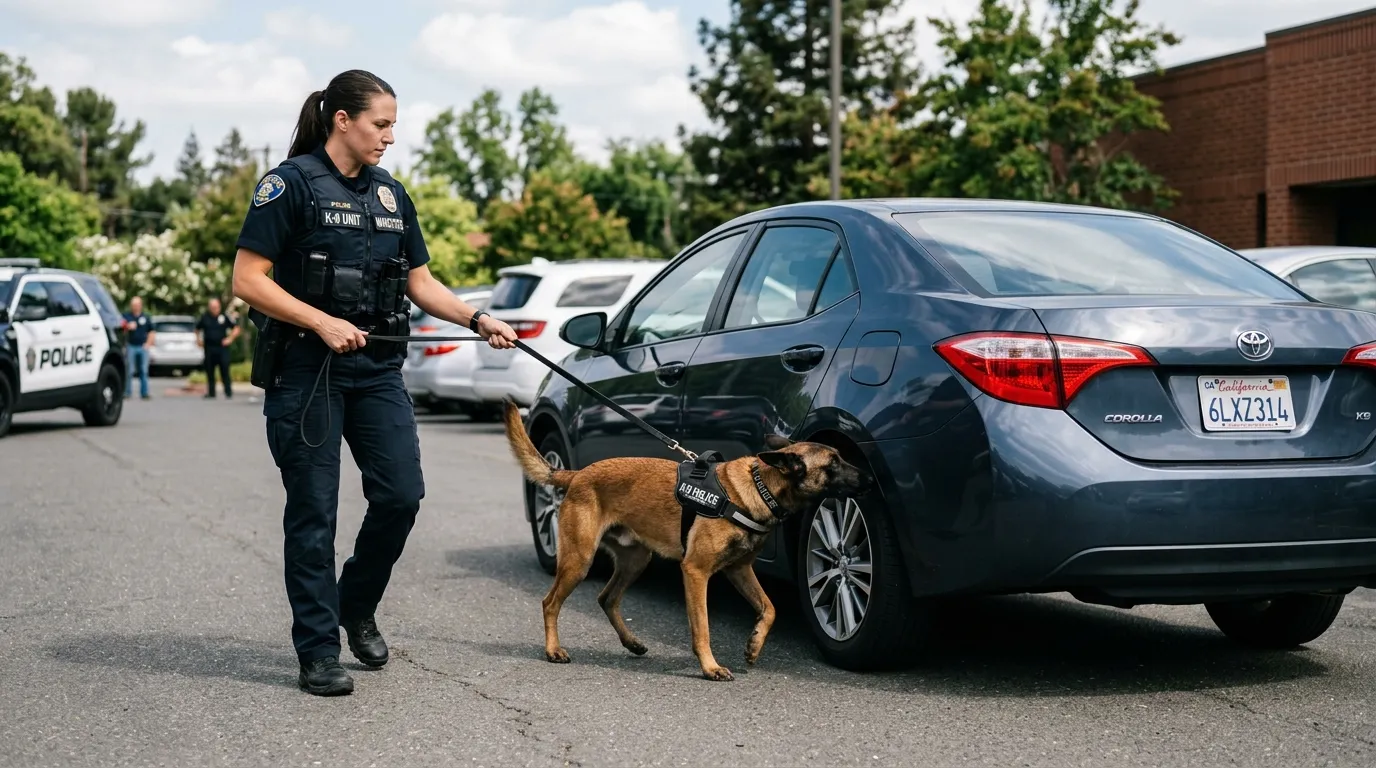
There is a drug so potent that just two milligrams — roughly the size of a few grains of table salt — is enough to kill an adult human. That drug is fentanyl, and it has become the deadliest substance in the history of the American drug crisis. As law enforcement agencies across the country scramble to intercept it, one of the most powerful tools in the fight is not found in a laboratory or a scanning machine. It lives in the nose of a well-trained dog.
Fentanyl-detecting K9 teams are now deployed across the United States at borders, highways, airports, schools, and correctional facilities. They are saving lives every day — but their work comes with unique and serious challenges that no other detection mission faces. This is the story of what it takes to put a dog on the front line of America’s opioid crisis, and why the canine nose may be one of our most important weapons in winning it.
Why Fentanyl Is Unlike Any Drug Dogs Have Faced Before
Drug-detecting dogs have worked alongside law enforcement for decades, trained to find marijuana, heroin, cocaine, and methamphetamine. Fentanyl is different — and the difference is terrifying in its scale. Fentanyl is a synthetic opioid that is up to 100 times more potent than morphine and approximately 50 times stronger than heroin. Synthetic opioids, primarily illicit fentanyl, continue to drive roughly three out of every four overdose fatalities in the United States, making it the single most lethal substance ever to enter the U.S. drug supply.
For context on what this means in real terms: a kilogram of fentanyl contains approximately one million doses. Just two milligrams is enough for a fatal overdose in most adults. Drug dealers now routinely mix fentanyl into other substances — pressed pills, powders, and even edibles — meaning users and law enforcement alike often encounter it without knowing it is there.
This extreme potency creates a problem that did not exist with previous drugs: the detection tool itself — the dog’s nose — becomes a potential victim. A detection dog must get close enough to a substance to detect its odor. With fentanyl, that proximity introduces genuine risk.
Can Dogs Actually Smell Fentanyl?
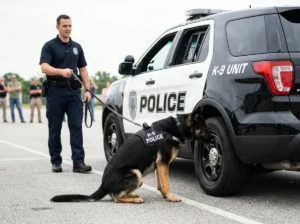 Yes — with the right training, they can. However, fentanyl presents a unique olfactory challenge because of its relatively low vapor pressure, meaning it releases fewer odor molecules into the air than drugs like cocaine or marijuana. This is what researchers describe as a “low odor signature,” and it is one of the key scientific problems that detection programs are actively working to solve.
A 2026 study from Florida International University, funded by the National Institute of Justice, is tackling this challenge head-on. Chemist Lauryn DeGreeff and her team are collaborating with the Naval Research Laboratory to develop a new detection method that focuses on a specific chemical compound detectable in fentanyl’s vapor signature. Their goal is to give dogs — and training programs — a more precisely defined target to work with, making detection faster, more reliable, and more consistent across deployments.
Despite the challenge of fentanyl’s low odor signature, well-trained detection dogs have proven remarkably effective. In 2024 alone, California Highway Patrol K9 teams helped seize nearly 823 pounds of fentanyl. The U.S. Customs and Border Protection began training its canine teams specifically on fentanyl as early as 2017 and currently operates the only federal canine academy with fentanyl-specific certification programs.
To understand why dogs are so capable of this work, our post on the science behind a dog’s nose explains the extraordinary olfactory biology that makes these animals uniquely suited for detection at a molecular level.
The Unique Safety Challenges of Fentanyl Detection Training
Training a dog to detect heroin or cocaine is dangerous in its own right, but fentanyl introduces a level of risk that requires an entirely different approach. The drug’s potency means that even trace amounts absorbed through mucous membranes — the moist tissues of the nose, eyes, or mouth — can trigger a life-threatening overdose. For a 70-pound detection dog, a poppy-seed-sized amount of powdered fentanyl is potentially lethal.
Passive Alert Training Is Now Standard
One of the most important safety adaptations in fentanyl K9 training is the shift to passive alert responses. Older narcotics detection protocols often used active alerts — where the dog would scratch, dig, or bite at the location of a detected substance. With fentanyl, that behavior is now considered unacceptably dangerous. Modern fentanyl detection dogs are trained exclusively to passive alerts: when they detect the scent, they sit, freeze, or make sustained eye contact with their handler. They never touch, paw, or disturb the source.
“Any time the dog alerts, we automatically presume it is the most dangerous drug, whether fentanyl, meth or other dangerous narcotics,” said CBP’s Director of Field Operations Canine Academy. “We automatically use all the safety protocols.” Handlers also keep dogs on the exterior of vehicles and packages rather than allowing them to enter or root through potential fentanyl sources.
Specialized Training Aids Make Safe Certification Possible
A key breakthrough in fentanyl detection training has been the development of specialized training aids — sealed containers that emit only the trace odor of fentanyl without releasing any particles or powder. These containers use filtration systems that allow dogs to learn and reliably associate the drug’s scent signature without any risk of actual exposure. One container delivers a diluted trace odor; another delivers the real scent in a fully sealed, particle-free format. This innovation — developed initially by the Royal Canadian Mounted Police and later adopted by U.S. agencies — made safe national certification programs possible for the first time.
Every Handler Now Carries Narcan for Their Dog
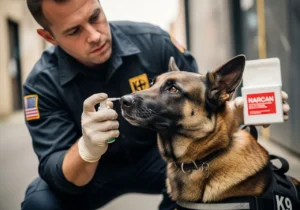
Across the country, canine handlers working in fentanyl-likely environments carry naloxone (Narcan) for both themselves and their dogs. The American Veterinary Medical Association has documented K9 opioid exposures and emphasizes that reversing an overdose within three to five minutes of the onset of clinical signs can save a dog’s life. The Idaho State Police, which completed full statewide fentanyl certification for all its K9 units in December 2025, reports that all handlers carry Narcan in their vehicles as standard protocol — for their own protection and their dog’s.
Where Fentanyl Detection Dogs Are Deployed
The deployment of fentanyl-trained K9 teams has expanded dramatically as the crisis has grown and as safe training protocols have matured. Dogs are now working fentanyl detection in a range of settings that would have been unimaginable a decade ago.
Borders and Ports of Entry
U.S. Customs and Border Protection K9 teams remain the nation’s primary canine defense against fentanyl entering the country. CBP dogs work alongside scanning technology at land crossings, cargo facilities, airports, and mail processing centers. Most illicit fentanyl enters the United States through legitimate trade channels — hidden in cargo shipments, commercial vehicles, and express mail — making the ability to quickly and accurately screen high volumes of goods essential. A detection dog can search a commercial vehicle in minutes that would take a human inspector hours to clear.
Highways and Interdiction Operations
State police and highway patrol agencies have become major investors in fentanyl K9 programs. California’s Highway Patrol now graduates canine classes specifically trained on fentanyl detection from their first day of instruction — a change from earlier programs that only added fentanyl to a dog’s scent portfolio after initial training on other drugs. These teams operate as part of broader counter-fentanyl operations, interdicting trafficking along major distribution routes.
Correctional Facilities and Schools
Fentanyl is increasingly being found inside jails, prisons, and even school environments — smuggled in through mail, visitor contact, and contaminated personal items. Correctional departments were actually among the earliest adopters of fentanyl-certified K9 teams, precisely because of the controlled environment and the critical need to prevent the drug from reaching incarcerated populations. Washington State’s Department of Corrections trains approximately 12 detection dogs annually, many of which are placed with local courts, jails, and law enforcement agencies facing two-year waiting lists for trained animals.
The Science Behind the Training Method
Training a dog to detect fentanyl follows the same foundational principles used in all scent detection work — but with modified safety parameters at every stage. The process begins with what trainers call odor imprinting: associating a specific scent signature with a high-value reward. Trainers use the dog’s favorite toy, typically an unscented towel or ball, and gradually introduce the fentanyl training aid’s scent to the toy. The dog learns that finding the odor source means the toy appears and play begins. Everything is a game.
As the dog’s confidence in the odor grows, hides become progressively more complex — different containers, vehicles, locations, and environmental distractions. Dogs must detect at high levels of accuracy to earn certification. Washington State’s K9 program manager reports that dogs must correctly identify at least 9 out of 10 targets to pass — and that in practice, all dogs he has certified detected a perfect 10 out of 10.
This is the same scientific foundation that underlies every detection mission our dogs perform. For a deeper understanding of how dogs process and remember specific scents through their olfactory system, our article on how dogs use their sense of smell provides the biological context behind these remarkable capabilities.
What the Future of Fentanyl Detection Looks Like
The battle against fentanyl is far from over. While national overdose deaths showed a modest decline in 2024 — the first sustained drop in years — fentanyl and its increasingly potent analogs remain the dominant driver of drug mortality in the United States. Researchers are already tracking the emergence of nitazenes and other next-generation synthetic opioids that may require entirely new detection strategies.
The work being done at Florida International University to identify exactly which chemical compound in fentanyl’s vapor signature dogs are responding to is critical to this future. If scientists can isolate and characterize that specific compound, it becomes possible to develop more consistent training materials, more accurate certification standards, and potentially even technology that can work alongside dogs to create a layered detection system of even greater reliability.
Detection dogs will not solve the opioid crisis alone. But they are — today, right now — intercepting shipments that represent thousands of lives. A well-trained K9 team operating at a border crossing or a highway stop is not just finding a drug. It is finding one million doses, or two million, compressed into a package that no human eye could identify. That is the power of the nose. That is why these dogs matter.
To learn more about how detection dogs are saving lives across all fields of service, read our post on how scent detection dogs save lives: real stories from the field.