
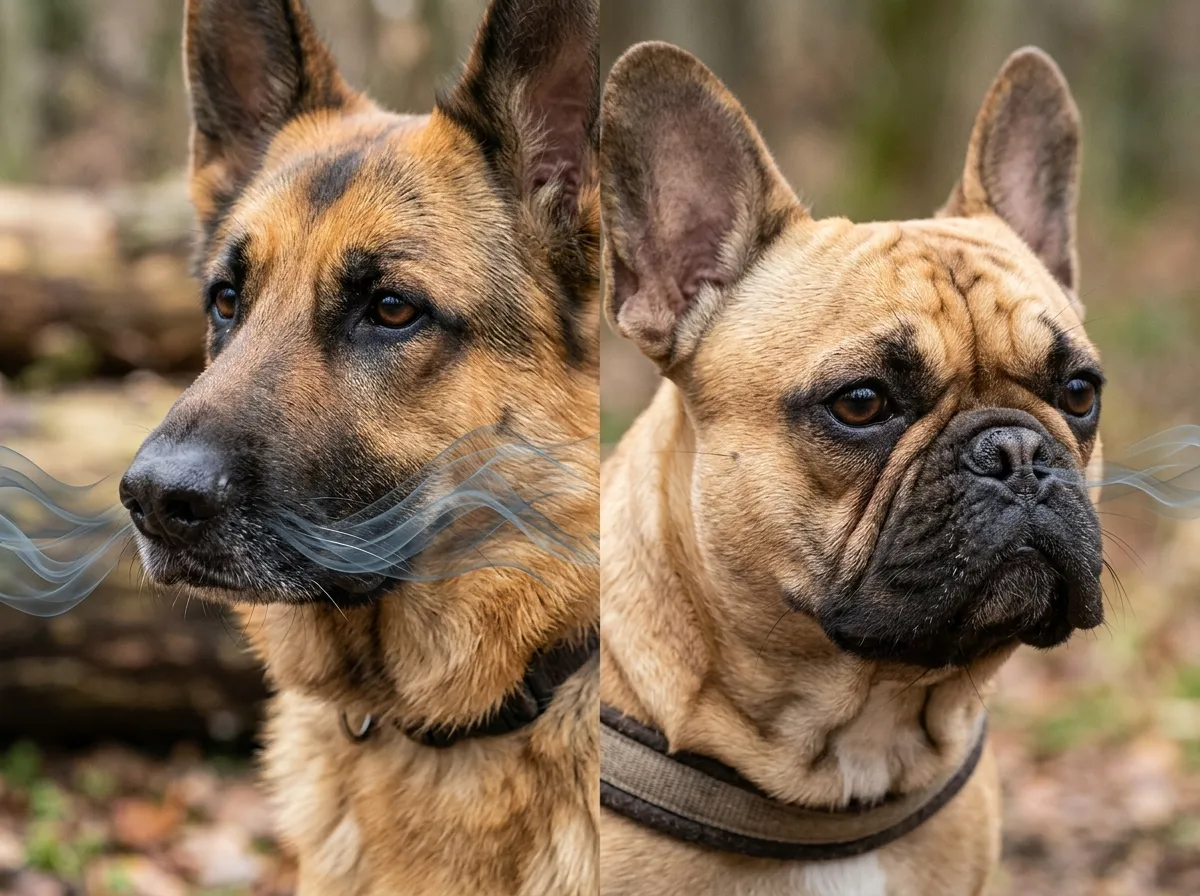
Not all dog noses are created equal. While every dog has a sense of smell that far surpasses our own, the truth is that breed and anatomy play a significant role in just how powerful that nose really is. From the elongated snout of a Bloodhound to the squashed face of a French Bulldog, the shape of a dog’s skull directly influences how much scent it can take in, process, and act upon.
For those involved in scent training, working dog programs, or simply choosing the right dog for detection work, understanding this relationship is essential. In this article, we break down the science behind canine olfaction, how skull shape and breed genetics shape scenting ability, and what it all means for detection work.
The Remarkable Baseline: Every Dog Nose Is Extraordinary
Before exploring the differences between breeds, it helps to appreciate how extraordinary all dog noses are by default. Humans have roughly 5 to 6 million olfactory receptors. Most dogs have between 220 and 300 million. The part of a dog’s brain dedicated to processing smell is proportionally about 40 times larger than ours.
Dogs can detect certain odors at concentrations as low as one part per trillion — the equivalent of a single drop dissolved in 20 Olympic-sized swimming pools. This baseline ability is what makes dogs so valuable in search and rescue operations, medical detection, and public safety work.
But within this already-impressive species, there is a wide spectrum. And that spectrum is shaped, in large part, by genetics and skull anatomy.
How Skull Shape Affects Olfactory Function
The canine skull comes in three broad anatomical categories, and each has a direct impact on how air flows through the nasal passages and how many scent-processing structures are present.
Dolichocephalic Dogs — The Long-Nosed Advantage
Dolichocephalic dogs have long, narrow skulls and extended muzzles. Think Greyhounds, Collies, and the legendary Bloodhound. In these breeds, the nasal cavity is long and spacious, allowing for a high density of olfactory epithelium — the tissue that contains scent receptors.
The longer the nasal passage, the more surface area exists for scent molecules to bind to receptors. These breeds also have highly developed nasal turbinates — the scroll-like bones inside the nose that warm, humidify, and filter incoming air while maximizing contact time between scent particles and receptor tissue.
Research published in the journal Animals (2026) confirms that complex nasal turbinate structures and specialized airflow patterns enhance odorant capture, making these dogs biologically primed for detection work.
Mesocephalic Dogs — The Versatile Middle Ground
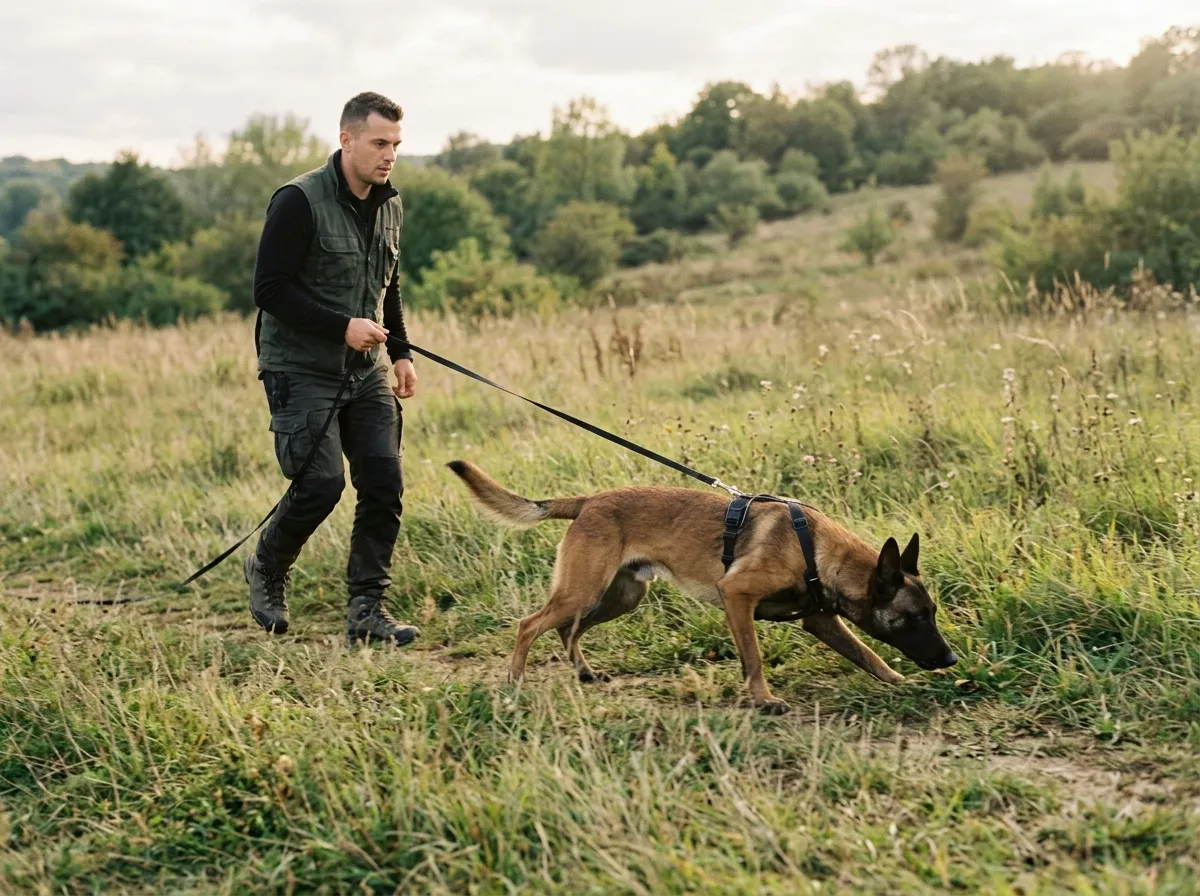
Mesocephalic dogs have medium-length skulls and proportionate muzzles. Labrador Retrievers, German Shepherds, and Belgian Malinois fall into this category. These breeds offer a strong balance of olfactory surface area and physical endurance, which is why they dominate professional detection and working dog programs worldwide.
Their nasal anatomy is well-suited to sustained scent work, and their temperament and trainability make them highly reliable in real-world detection environments.
Brachycephalic Dogs — The Compressed Nose Challenge
Brachycephalic dogs have short, wide skulls and dramatically compressed muzzles. Bulldogs, Pugs, Boxers, and French Bulldogs are the most recognizable examples. While these dogs are beloved for their distinctive appearance and personality, their skull shape creates real anatomical limitations for scent work.
The compression of the skull shortens the nasal passages, reduces the surface area of olfactory epithelium, and can restrict airflow. In some lines, this is associated with reduced functional scent potential. These dogs may also experience breathing difficulties that further limit their ability to engage in sustained or intense scenting activity.
This does not mean brachycephalic dogs cannot smell — they absolutely can, and still surpass humans by a wide margin. But when compared to dolichocephalic or mesocephalic breeds, their olfactory capacity is measurably lower.
The Genetics Behind Breed-Level Scent Differences
Skull morphology is not the only factor at play. Centuries of selective breeding have also shaped the genetic architecture of olfaction itself — including the number of functional olfactory receptor genes a breed carries.
Dogs were domesticated and selectively bred for specific purposes: herding, hunting, guarding, and tracking. Breeds developed for hunting and tracking — Bloodhounds, Beagles, Coonhounds — were selected over generations specifically for olfactory sensitivity. This means they not only have the physical anatomy for superior scent detection, but also the genetic coding that supports it.
In contrast, breeds selected primarily for appearance, companionship, or guarding may not have undergone the same olfactory selection pressure. Their genes related to smell may be less optimized, even if their noses still function well in everyday contexts.
A 2026 review from Warsaw University of Life Sciences, published in Animals, highlighted that domestication and selective breeding have measurably shaped breed differences in olfactory capacity, with some lines showing altered sensory potential depending on the traits that were historically prioritized in breeding programs.
What This Means for Scent Training and Detection Work
Understanding breed-based olfactory differences has real-world implications for anyone involved in training or deploying detection dogs. It affects breed selection, training approach, and realistic expectations for performance.
Choosing the Right Breed for Detection Work
For professional detection programs — whether in law enforcement, medical screening, search and rescue, or conservation work — breed selection is a critical first step. The most commonly deployed breeds in these fields are not chosen arbitrarily. German Shepherds, Belgian Malinois, Labrador Retrievers, and Bloodhounds consistently rise to the top for good reason.
These breeds combine strong olfactory anatomy with behavioral traits that support sustained detection work: high drive, trainability, resilience, and environmental confidence. A 2026 study published in PLOS One found that professional handlers identified key traits such as persistence, independence, scent orientation, and environmental confidence as essential characteristics in ideal detection dogs — traits that align closely with the working breeds most commonly selected.
Training Brachycephalic Breeds for Nose Work
Does this mean flat-faced dogs have no place in scent activities? Not at all. Recreational nose work and scent sports can be excellent enrichment activities for brachycephalic breeds, provided that sessions are kept shorter, intensity is managed, and the dog’s breathing is monitored carefully.
For pet owners interested in engaging their Bulldog or Pug in scent games at home, the activity can be tremendously rewarding for both dog and owner. It simply requires realistic expectations and careful management of exercise limits. To understand how dogs process smell at a neurological level, our article on how dogs use their sense of smell provides a solid foundation.
Top Breeds for Scent Detection — Ranked by Olfactory Strength
While every working dog situation requires individual evaluation, the following breeds are widely recognized as the most capable scent detectors based on anatomy, genetics, and real-world performance.
1. Bloodhound
The Bloodhound holds a near-legendary status in the world of scent detection. With the highest density of olfactory receptors of any breed and long, pendulous ears that help funnel scent particles toward the nose, the Bloodhound is biologically engineered for tracking. Their scent trails have been used as admissible evidence in courts of law in the United States.
2. Beagle
Compact, determined, and nose-driven, the Beagle is a powerhouse scent detector in a small package. Beagles are widely used in airport security and agricultural detection for their ability to identify contraband food items and plant materials in checked luggage. Their manageable size and friendly temperament make them particularly effective in public-facing environments.
3. German Shepherd
One of the most versatile working dogs in the world, the German Shepherd combines outstanding olfactory ability with intelligence, endurance, and trainability. They are used across law enforcement, military operations, search and rescue, and medical detection programs globally.
4. Belgian Malinois
Increasingly favored over the German Shepherd in military and elite law enforcement contexts, the Belgian Malinois is lighter, faster, and intensely driven. Their scent detection abilities are on par with the German Shepherd, and their work ethic and physical endurance often exceed it.
5. Labrador Retriever
Perhaps the most widely used detection breed in civilian and humanitarian contexts, the Labrador Retriever combines a strong nose with an eager-to-please temperament that makes training especially effective. Labs are commonly found in medical detection programs, mine detection, and conservation scent work. To learn more about dogs saving lives through their scent abilities, read our piece on the science behind a dog’s nose as a life-saving superpower.
Other Factors That Influence Scent Performance
 Breed and skull shape are powerful predictors of olfactory potential, but they are not the only variables that matter. Even within the same breed, individual differences can be significant.
Physical Health and Fitness
A dog’s overall health directly affects its scenting performance. Respiratory issues, nasal infections, allergies, or simply being out of physical condition can all reduce a dog’s ability to detect and follow scent effectively. Regular veterinary care and physical conditioning are essential components of any detection dog program.
The Microbiome and Diet
Emerging research suggests that a dog’s gut and upper airway microbiome — shaped by diet, environment, and overall health — may influence its sensory and cognitive readiness for detection tasks. While direct causal links are still being studied, this is an exciting frontier in canine olfactory science that may reshape how we approach detection dog health and nutrition in coming years.
Stress, Fatigue, and Living Conditions
Detection performance is not purely a matter of anatomy. Stress, fatigue, and poor living conditions can impair a dog’s ability to focus and perform scent work. Dogs that are well-rested, emotionally stable, and working in a positive reinforcement environment consistently outperform those under chronic stress. This is one reason why ethical, reward-based training methods are not just humane — they are operationally superior.
Training Quality and Handler Relationship
Even the most gifted nose in the world needs skilled, consistent training to reach its potential. Research has shown that dogs can learn shortcuts in training when methods are not carefully designed — finding ways to earn rewards without genuinely detecting the target scent. This is why ongoing research into training methodology, such as the work of chemist Lauryn DeGreeff at Florida International University, is so important to the field.
Choosing the Right Dog for the Right Job
The relationship between breed, skull shape, and scent ability is not a simple hierarchy where one type of dog is universally “better.” It is a question of fit. The right dog for a wilderness search and rescue team may not be the right dog for an airport detection program. The right dog for a medical detection study may not be the right choice for an avalanche rescue unit.
What the science tells us is that olfactory anatomy matters, breed history matters, and individual traits matter. The best detection programs take all three into account when selecting, training, and deploying their canine partners.
For anyone exploring the world of scent training — whether for professional deployment or as a hobby — understanding the biology behind the breed is the foundation of everything that follows. A dog’s nose is extraordinary. Knowing what shapes its power helps us use it wisely.
Want to understand how this incredible ability is put to work in real-world missions? Explore our article on 10 fascinating facts about dog scent detection for a broader look at what these remarkable animals can do.