
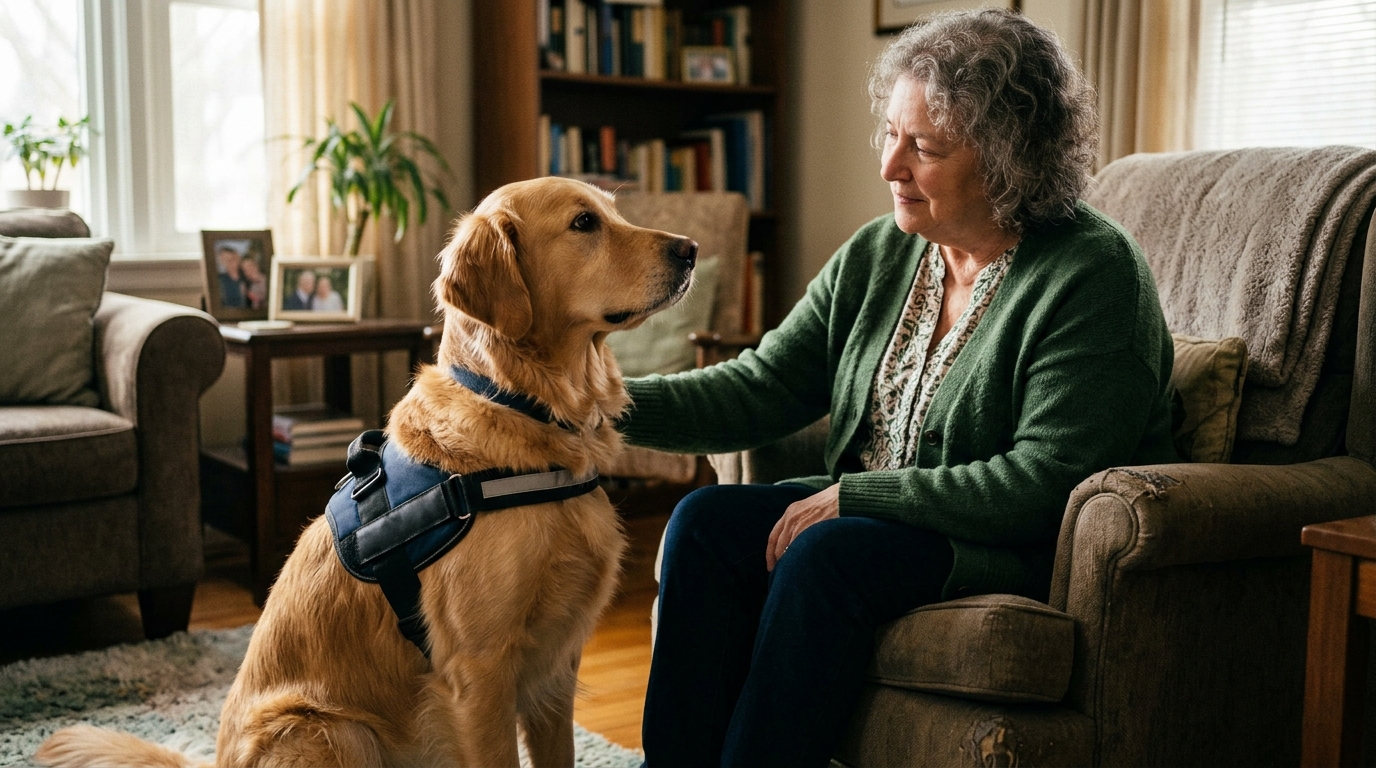
For the estimated 50 million people worldwide living with epilepsy, unpredictability is one of the most disabling aspects of the condition. A seizure can arrive without warning — while crossing a street, cooking a meal, bathing, or sleeping — and the fear of that next episode shapes every decision, every plan, and every moment of independence. What if a dog’s nose could change that?
Seizure alert dogs are trained service animals that can detect the chemical signals of an oncoming epileptic episode and warn their handler before it occurs — giving them time to reach safety, take medication, contact help, or simply get to the ground. For decades, this capability was observed anecdotally. Now, a growing body of rigorous scientific research has confirmed what handlers have known for years: seizures have a smell, dogs can find it, and that ability is one of the most remarkable applications of canine olfaction in medicine today.
Epilepsy — The Challenge of Unpredictability
Epilepsy is one of the most common neurological conditions in the world, affecting people of every age, background, and geography. It is characterized by recurrent seizures — sudden surges of abnormal electrical activity in the brain that can cause convulsions, loss of consciousness, confusion, or a range of other symptoms depending on the type and location of the neural disruption.
For approximately 30 to 40 percent of people with epilepsy, seizures cannot be adequately controlled with medication or surgery. These individuals live with a persistent and unpredictable risk that limits their independence, affects their employment, and significantly impacts their quality of life. The risk of sudden unexpected death in epilepsy — known as SUDEP — is estimated to be 24 times greater than in the general population, making effective early warning systems not just a matter of comfort but of survival.
The Gap That Alert Dogs Fill
Current seizure monitoring technology — wearable sensors, EEG devices, accelerometers — can detect a seizure once it is underway and alert a caregiver. What most technology cannot yet do reliably is predict a seizure before it begins. That pre-ictal window — the period before seizure onset when the brain and body are undergoing the chemical changes that precede an episode — is precisely where a trained dog operates.
The implications are significant. A warning that arrives after a seizure has started offers response capability. A warning that arrives before a seizure starts offers prevention of injury, time to reach safety, and the possibility of intervention. That is the difference between a seizure response dog and a seizure alert dog — and it is what the science is now working to understand and reliably replicate through training.
The Science Behind Seizure Scent
The central question that researchers needed to answer before seizure alert dog training could be placed on a scientific footing was whether epileptic seizures produce a consistent, detectable odor at all. For years, the answer was unknown. Some dogs were observed alerting before seizures, but whether they were responding to a scent, subtle behavioral changes, or random coincidence was unclear.
The answer came from a landmark 2019 study published in Scientific Reports by Dr. Amélie Catala and colleagues from the University of Rennes in France, working with Medical Mutts, a US-based service dog organization. The researchers collected sweat and breath samples from seven epilepsy patients across three conditions — resting, exercising, and during a seizure — and presented them to five trained detection dogs in a seven-choice discrimination task.
The Universal Seizure Odor — A Critical Discovery
The results were striking on multiple levels. All five dogs demonstrated an exceptional ability to discriminate seizure samples from non-seizure samples, with sensitivity and specificity levels among the highest reported in any disease detection study. But perhaps the most important finding was the universality of the seizure odor.
The seven patients in the study had different types of epilepsy and different seizure triggers. Despite these individual differences, the dogs consistently identified the seizure samples across all patients and seizure types — indicating that epileptic seizures produce a common chemical signature regardless of the individual or the specific seizure mechanism. This was, as the researchers described it, an unexpected and welcome finding that fundamentally changes how seizure alert dog training can be approached.
Previously, trainers had no confirmed target odor to work from. Now, they did. A universal seizure scent means that training samples do not need to come exclusively from the individual handler — a practical limitation that had significantly complicated training program design.
How Far in Advance Can Dogs Detect a Seizure?
One of the most remarkable aspects of seizure alert dog capability is the detection window. While the 2019 Scientific Reports study used samples collected during seizures — confirming the scent exists — subsequent research and clinical observation have documented dogs alerting significantly earlier. According to research cited in a clinical trial registry entry on VOC biomarkers for seizure prediction, the olfactory signature of an oncoming seizure can be detectable up to three hours before onset.
This pre-ictal detection window is consistent with what is known about the physiological changes that precede a seizure. As the brain undergoes the gradual electrical and metabolic changes that build toward a seizure event, the body’s chemistry shifts — producing altered profiles of VOCs in breath, sweat, and skin that a trained dog’s nose can detect long before any behavioral or neurological symptom becomes visible. As we explore in our article on how dogs use their sense of smell, the canine olfactory system operates at a level of chemical sensitivity that no current sensor technology can match — making dogs uniquely positioned to detect these early, subtle changes.
What the Research Confirms — Accuracy and Validation
The body of research validating seizure alert dog accuracy has grown substantially since the 2019 Scientific Reports study. In 2021, a study from Queen’s University Belfast confirmed the findings using pet dogs with no prior formal scent training — demonstrating that the ability to detect seizure odor is not limited to specially trained working dogs.
According to Epilepsy Action UK, the Queen’s University Belfast research led by Dr. Neil Powell found that untrained pet dogs could reliably detect seizure-associated odors using a Remote Odour Delivery Mechanism — a finding that strengthens the case for the universality and robustness of the seizure scent signature. The conclusion was direct: there is a unique, volatile smell linked to epileptic seizures, detectable by dogs, who in turn can warn their owner that a seizure is likely to occur.
Identifying the Chemical Bouquet
Researchers have also made progress in identifying the specific VOCs that constitute the seizure scent. Work by Gary Arnold, CEO and founder of Know Biological — in collaboration with Sandia National Laboratories — identified a group of eight VOCs that appear to be unique to seizures. These compounds are released from the skin and breath as the body undergoes the metabolic and neurological changes associated with seizure activity.
This chemical identification work is critically important because it enables the development of technology that can replicate what dogs do. According to CURE Epilepsy, a miniaturized sensor system developed by Sandia National Laboratories was able to detect key seizure-associated gases from a skin swab 22 minutes before seizure onset — a technology directly inspired by the capabilities of seizure alert dogs and made possible by the chemical roadmap their detection work provided.
The Relationship Between Dogs and Technology
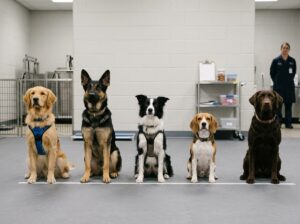
This is the pattern that repeats across the field of medical scent detection: dogs identify the target, science characterizes the chemistry, and technology works to replicate the detection at scale. The dog is not replaced by the sensor — it is the proof of concept and the performance benchmark that sensor development is trying to reach. In seizure detection, as in so many other areas of medical olfaction, the dog’s nose is setting the standard that every electronic nose in development is chasing.
How Seizure Alert Dogs Are Trained
The training of a seizure alert dog is a specialized process that builds on the foundational principles of scent detection work — odor imprinting, positive reinforcement shaping, and progressive generalization from controlled training environments to real-world deployment. What makes seizure alert training distinctive is the nature of the target odor and the challenge of collecting and preserving training samples.
Sample Collection and Odor Imprinting
Training samples — typically gauze pads or cloth worn during a seizure, or saliva and sweat collected during an episode — are collected, sealed, and frozen as soon as possible after a seizure event to preserve their VOC profile. The dog is then exposed to these samples in controlled discrimination exercises, learning to identify and alert to the target scent against a range of distractor odors.
Given the confirmation of a universal seizure odor, training programs can now supplement individual handler samples with samples from other epilepsy patients — a significant practical advance that makes the early stages of training more accessible and consistent. As the dog’s discrimination accuracy develops, training is progressively transferred to real-life conditions — working in the home, in public, and alongside the specific handler the dog will be placed with.
Alert Behaviors and Response Training
A seizure alert dog’s trained alert behavior is its primary safety communication tool. Common alerts include pawing at the handler, placing its head in the handler’s lap, persistent nudging, circling, or vocalizing. Some dogs are also trained in seizure response behaviors — staying beside the handler during a seizure, activating an alarm device, or retrieving a phone or medication kit. The combination of alerting before the seizure and responding during it creates a comprehensive safety support system for handlers living alone or in situations where a human caregiver cannot be continuously present.
This dual capability — prediction and response — mirrors the broader pattern we explore throughout our site of dogs applying their extraordinary sensory abilities across multiple stages of a health event. To understand how this applies across a range of life-saving contexts, read our article on the science behind a dog’s nose as a life-saving superpower.
Life With a Seizure Alert Dog — What It Means for Handlers
For people with drug-resistant epilepsy, a seizure alert dog can be genuinely transformative. The most consistent finding across the qualitative research on seizure alert dog partnerships is not reduced seizure frequency — the dog does not change the underlying neurology — but dramatically improved quality of life and restored independence.
Safety, Confidence, and Independence
Handlers consistently report that seizure alert dogs allow them to perform everyday activities that SUDEP risk or injury fear had previously made impossible — cooking, bathing, crossing roads, traveling on public transport, living alone. The knowledge that a reliable early warning system is always present removes a layer of chronic anxiety that, for many people with epilepsy, is as disabling as the seizures themselves.
Children with epilepsy — and their parents — are among the populations who report the greatest impact. A dog that alerts a sleeping parent to a child’s nocturnal seizure, or that accompanies a teenager to school and alerts a teacher before an episode, provides a safety layer that no wearable device currently matches for reliability and responsiveness in real-world conditions.
Limitations and Realistic Expectations

Seizure alert dog programs are not without limitations. Not every dog has the natural aptitude for this work. Training is time-intensive and expensive. Performance varies between dogs and between handlers, and no seizure alert dog — however well trained — provides a 100 percent guarantee of detecting every episode. Handlers are counseled to treat their dog as a complement to medical management and technology monitoring rather than a replacement for either.
What the science makes clear, however, is that the capability is real, the chemistry is understood, and the potential to improve and standardize training is growing with every new study. For the millions of people for whom current epilepsy management leaves meaningful gaps, a dog that can smell what is coming before it arrives represents one of the most compelling intersections of canine biology and human need anywhere in medicine today.
A Nose That Sees What the Brain Cannot
Epilepsy takes the one thing people most need — predictability — and makes it impossible. A seizure alert dog gives some of that predictability back. Not through technology, not through medication, but through 300 million olfactory receptors trained to find a scent that science has now confirmed exists in every person, before every seizure, waiting to be detected.
The dog does not understand epilepsy. It understands the smell that comes before the storm. And in that knowledge — biological, instinctive, and now scientifically validated — lies one of the most powerful partnerships between humans and dogs ever documented. To explore more about the full range of medical conditions that trained detection dogs are helping to manage and detect, read our comprehensive guide on medical detection dogs and disease screening.