
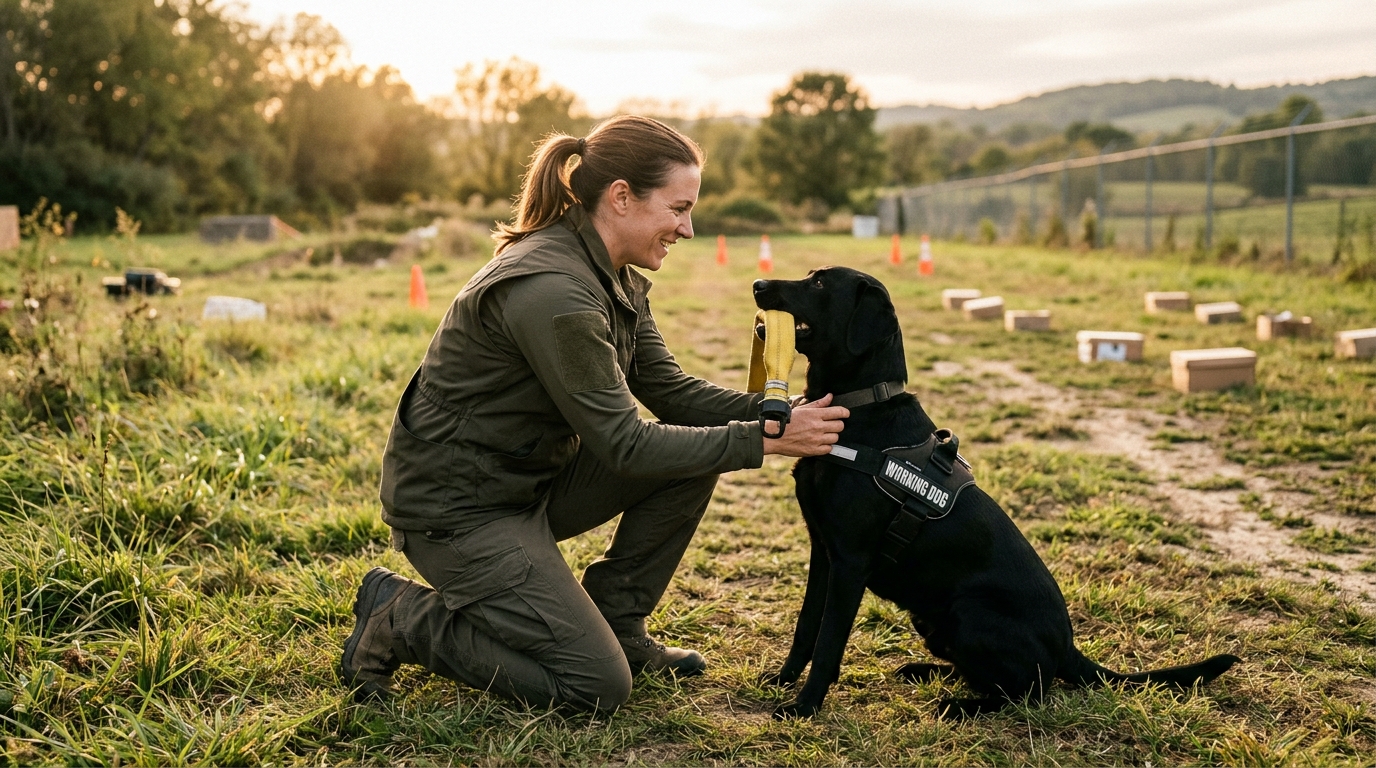
A detection dog is not born knowing how to find explosives, cancer, or a missing person. It is built — through months of careful, science-based training that transforms a puppy’s natural love of sniffing into one of the most precise and reliable detection instruments in the world. Understanding how that transformation happens is not just fascinating — it fundamentally changes how we appreciate what these dogs do every day.
The training of a detection dog is a discipline that sits at the intersection of behavioral science, olfactory research, and the ancient bond between humans and dogs. It draws on decades of applied learning theory, and it is advancing rapidly as new research sheds light on how dogs learn scent associations most effectively. Whether you are a dog enthusiast, a prospective handler, or simply curious about the science behind the nose, this guide breaks down how detection dogs are trained from the ground up.
The Foundation — Why Dogs Are Built for This Work
Before any training begins, it helps to appreciate why dogs are so extraordinarily well-suited to scent detection work in the first place. A dog’s nose contains up to 300 million olfactory receptors — compared to roughly five to six million in humans — and the region of the brain dedicated to analyzing scent is proportionally about 40 times larger than ours. Dogs experience the world primarily through smell, constructing a detailed chemical picture of their environment with every breath.
Beyond raw receptor count, the dog’s nasal anatomy includes a system of scroll-like bones called turbinates that maximize the contact time between scent molecules and receptor tissue, and a specialized secondary olfactory organ — the vomeronasal organ — that processes chemical signals beyond the reach of normal olfactory pathways. This biological architecture makes dogs capable of detecting target odors at concentrations measured in parts per trillion — far beyond the sensitivity of any electronic sensor currently in use.
As we explore in our detailed article on why your dog’s sense of smell is far superior to yours, this capability is not just a matter of degree — it represents a fundamentally different relationship with the chemical world than humans experience. Training does not create this ability. It focuses, shapes, and deploys it.
Step One — Odor Imprinting
The first stage of detection dog training is odor imprinting — the process of creating a reliable, lasting association between a specific target scent and a positive reward in the dog’s mind. This is the foundational step on which all subsequent training is built, and getting it right is essential.
Classical Conditioning — The First Association
Imprinting begins with classical conditioning — the same principle Ivan Pavlov demonstrated with his famous bell-and-food experiments. The dog is exposed to the target odor and simultaneously receives a high-value reward, typically food or a favourite toy. Through repeated pairings of the scent and the reward, the dog forms an involuntary association: this smell predicts something good. The target odor becomes meaningful — not just another smell among thousands, but a signal that something rewarding is about to happen.
According to the American Kennel Club, this reward-based approach to conditioning — also known as positive reinforcement training — is consistently recognized as the most effective and ethical method for training working dogs, and is now standard across professional detection programs worldwide. It works because it harnesses the dog’s natural motivation rather than suppressing its behavior through fear or correction.
Choosing the Right Target Odor Presentation
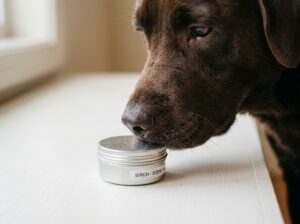
How the target odor is presented during imprinting matters enormously. Research published in Frontiers in Veterinary Science by Lazarowski and colleagues at Auburn University’s Canine Performance Sciences Program in 2025 found that the timing and delivery of odor presentations during initial conditioning significantly affects how quickly and reliably a dog learns the target association. The shorter the delay between odor and reward, the more efficient the conditioning — a finding that has practical implications for how trainers structure early imprinting sessions.
Sample preparation is equally important. Detection training aids — the physical containers or materials used to present the target odor during training — must be prepared and stored in ways that accurately represent the real-world odor the dog will need to identify in the field. Contamination, odor bleed, and inconsistent concentration can all undermine the quality of imprinting and create confusion that surfaces as false positives or missed detections during operational deployment.
Step Two — Operant Conditioning and Shaping the Search
Once the dog has formed a reliable odor-reward association through classical conditioning, training progresses to operant conditioning — the process of shaping active, deliberate behavior through consequences. Where classical conditioning creates an involuntary association, operant conditioning teaches the dog to make choices and take actions to earn its reward.
Teaching the Dog to Search
In operant conditioning, the dog learns that performing a specific behavior — in this case, actively seeking the target odor in the environment — produces a reward. The trainer begins by rewarding any engagement with the target scent, then progressively raises the criteria, rewarding the dog only for more precise, sustained, or independent searching behavior. Through this incremental shaping process, the dog learns not just that the target odor is rewarding, but that actively hunting for it and communicating its location to the handler is how the reward is earned.
This active searching behavior — the purposeful, nose-driven sweep of an environment in pursuit of a specific scent — is what distinguishes a detection dog from a dog that simply enjoys sniffing. The search is a trained behavior, shaped through thousands of repetitions of reward-based operant conditioning.
Marker Training — Precision Communication
A critical tool in modern detection dog training is the marker — a distinct, consistent signal that communicates to the dog the precise moment its behavior is correct. The most common marker is a clicker, a small handheld device that produces a sharp, distinct sound when pressed. Used immediately at the moment of correct behavior, the clicker acts as a bridge between the behavior and the reward — allowing the trainer to communicate with split-second precision across distance and through distractions.
The 2025 Auburn University study in Frontiers in Veterinary Science specifically investigated marker training in detection dogs, finding that markers facilitated the transfer of learned behavior from the specific training environment to novel search contexts — a critically important quality known as generalization. A dog that learns to find a target odor in one environment but cannot apply that skill in an unfamiliar setting has limited operational value. Marker training appears to support the broader, more flexible learning that real-world detection work requires.
Building the Alert Behavior
Finding the target odor is only half the job. A detection dog must also communicate its finding to its handler in a clear, consistent, and reliable way. This communication behavior — known as the alert or indication — is trained separately and shaped to meet the requirements of the specific detection context the dog will work in.
Passive Versus Active Alerts
Detection dog alerts fall into two broad categories. Passive alerts — such as sitting, lying down, or freezing in place — are used in contexts where disturbing or damaging the target area would be problematic. Explosive detection dogs, for example, are almost always trained to passive alerts, since any digging, scratching, or pawing at a suspected device would be dangerous. Active alerts — such as scratching, barking, or pawing — are used in contexts where the target is robust and the behavior helps pinpoint its location, such as tracking live human scent in search and rescue work.
The choice of alert behavior is determined by the detection application, and it is shaped through the same reward-based operant conditioning used to build the search behavior — rewarding the specific alert posture at the moment of odor detection until it becomes a reliable, automatic response to finding the target scent.
The Importance of Odor Generalization
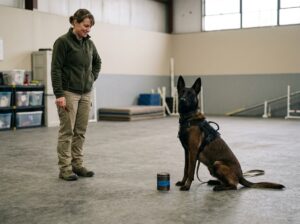
One of the most practically important — and most actively researched — aspects of detection dog training is generalization: the dog’s ability to recognize the target odor across variations in concentration, matrix, environment, and presentation that differ from the training samples. A drug detection dog trained on one batch of heroin must be able to recognize the same scent signature in a different batch, concealed in a different container, at a different concentration, in a different environment.
Research published in Animal Cognition found that the method used to train multiple target odors significantly affects the dog’s generalization ability. Dogs trained using an intermixed method — where multiple target odors are presented in alternating sequence rather than one at a time — showed significantly better generalization and fewer false negatives than dogs trained with the conventional sequential method. These findings are already informing updated training protocols across professional detection programs.
Proofing — Preparing for the Real World
The transition from controlled training environment to real-world operational deployment is one of the most challenging phases of detection dog development. In training, the target odor is always present somewhere and the dog always finds it. In the real world, searches can be blank — no target present — and the dog must learn to keep searching without finding, then communicate a negative result through the absence of an alert.
Distraction Training
Proofing involves progressively exposing the dog to the full range of distractors it will encounter in its working environment — competing odors, unfamiliar surfaces and containers, environmental noise, the presence of strangers, and the physical demands of working in challenging terrain or weather. Each distractor is introduced systematically, with the dog rewarded for maintaining focus on the target task despite the competing stimulation.
This process takes time — often months — and requires careful attention to the dog’s stress levels, motivation, and confidence. A dog that is rushed through proofing and deployed before it is fully prepared may develop false positive behavior — alerting to distractors or alerting without detecting the target simply to earn a reward. This is precisely the training shortcut problem that research by Lauryn DeGreeff at Florida International University has highlighted in fentanyl detection contexts, and it underscores why rigorous proofing is not optional — it is the difference between a reliable detection tool and an unreliable one.
Blank Searches and Intermittent Reinforcement
Teaching a dog to work blank searches reliably requires a careful transition from continuous reinforcement — where every correct detection earns a reward — to intermittent reinforcement, where rewards come on a variable schedule. As the AKC Detection Dog Task Force has documented, intermittent reinforcement in operational conditions is the reality of detection work: not every search pays a reward, and the dog must maintain motivation and precision even through extended blank searches. When trained correctly, intermittent reinforcement actually strengthens the behavior over time — making it more persistent and resistant to extinction than behavior reinforced on every occasion.
The Handler — The Other Half of the Team
A detection dog does not work in isolation. The handler is an equal and essential partner, and handler training is as important as dog training in determining team performance. As conservation dog handler Jessie Holder of the AKC has noted, working a detection dog is far more than holding the end of a leash — it requires the ability to read the dog’s body language, interpret subtle behavioral changes that signal odor contact, make real-time decisions about search patterns, and maintain the dog’s motivation and welfare across the duration of a deployment.
Reading the Dog — Pre-Alert Behavior
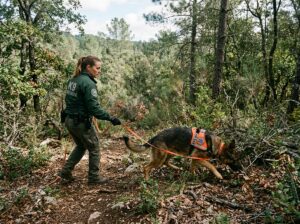
One of the most important skills a detection dog handler develops is the ability to recognize pre-alert behavior — the subtle changes in the dog’s movement, posture, breathing, and attention that signal it has encountered the target odor before it reaches its formal alert position. A dog working a scent cone will typically show a change of behavior as it enters the odor plume: a slight head turn, an acceleration of sniffing, a change in direction or pace. An experienced handler recognizes these signals and works with the dog to locate the source, rather than waiting passively for the formal alert.
This handler awareness is what elevates a functional detection team to an exceptional one — and it is built through the same process of observation, feedback, and practice that shapes the dog’s own behavior. To see how this trained partnership translates into real-world life-saving outcomes, read our article on how scent-detection dogs save lives in the field.
How Long Does It Take to Train a Detection Dog?
The timeline for training a detection dog varies widely depending on the detection application, the individual dog’s aptitude and prior training history, and the complexity of the target odor and operational environment. Entry-level detection dogs for single-odor applications — such as basic narcotics detection — can reach deployment-ready standard in as little as eight to twelve weeks of intensive training. Medical detection dogs, conservation detection dogs, and multi-odor working dogs typically require six months to two years of progressive training before they reach operational reliability.
What all detection training programs share, regardless of timeline, is the same scientific foundation: reward-based operant conditioning, precision marker training, systematic odor imprinting, and rigorous proofing against real-world distractors. These principles are not shortcut-able. They are what make the difference between a dog that can find a target odor in a controlled environment and a dog that can find it anywhere — under any conditions, in any environment, every time it matters.
For a broader look at the range of remarkable things these trained dogs can do once they complete their training journey, explore our article on 10 fascinating facts about dog scent detection — and the extraordinary capabilities that science-based training unlocks.