
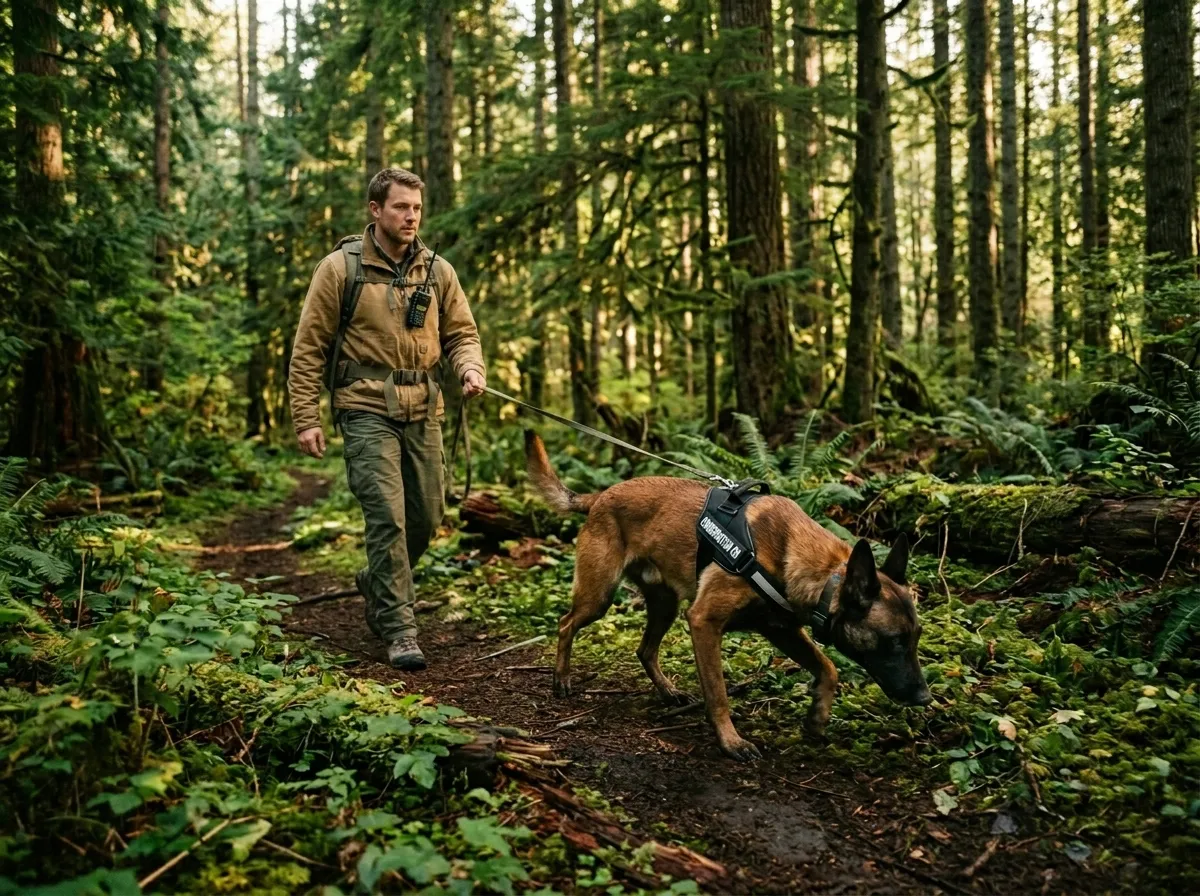
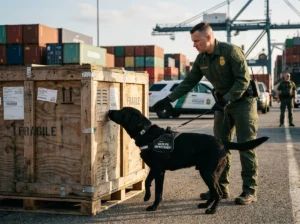
Deep in a forest in the Pacific Northwest, a dog sweeps silently through the undergrowth. It is not tracking a missing person or hunting a criminal. It is following the scent of grizzly bear scat — invisible to every researcher, camera trap, and radio collar in the area — and it will find it in minutes rather than days. Across the world, in an African port, another dog moves methodically along a row of shipping containers. Inside one of them, buried beneath legal cargo, is a quantity of ivory. The dog stops, sits, and waits. Its nose has just intercepted a wildlife crime.
Conservation detection dogs are one of the most powerful and underutilized tools in the global effort to protect biodiversity. For decades, the extraordinary olfactory abilities that make dogs invaluable in law enforcement and medical detection have been applied to an entirely different frontier — protecting the natural world. The results have been remarkable, and the science behind this work is growing stronger every year.
Why Conservation Needs a Better Nose
Monitoring and protecting wildlife is one of the most logistically challenging tasks in science. Many of the species that need protection most urgently are also the hardest to find. They are nocturnal, deeply camouflaged, confined to remote terrain, or so reduced in number that traditional survey methods — camera traps, hair snares, visual transects, radio collaring — simply cannot locate them reliably or cost-effectively.
The fundamental challenge of conservation biology is that you cannot protect what you cannot find. Accurate population data, species distribution maps, and early detection of invasive threats all depend on the ability to locate biological evidence across vast, often inaccessible landscapes. This is where detection dogs offer something no other tool can match.
The Advantage of Scent Over Technology
Camera traps miss nocturnal species that move outside sensor range. Hair snares require an animal to physically contact a specific point. Radio collaring is invasive, expensive, and limited to the animals already captured. Dogs, by contrast, can sweep large, irregular areas non-invasively, follow a scent trail regardless of visibility conditions, and locate biological samples — scat, feathers, fur, nesting material — that no other method would detect.
According to a peer-reviewed critical review published in Ecology and Evolution, conservation detection dogs are generally quicker, can cover wider areas, and find more samples than humans and other analytical tools across a broad range of habitats and target species. Their ability to work non-invasively — without disturbing the animals they are searching for — makes them especially valuable for monitoring rare, stressed, or breeding populations where disturbance could itself cause harm.
Finding What Humans Cannot
The most established use of conservation detection dogs is scat detection — locating the feces of target wildlife species across large survey areas. Scat is a treasure trove of biological information. From a single sample, researchers can extract genetic data for individual identification, hormone levels that indicate reproductive status and stress, dietary information that reveals resource use, and pathogen data that flags disease threats. A single trained dog can locate multiple species’ samples simultaneously, across terrain that would take a human research team days or weeks to cover.
Pioneering Work at the University of Washington
The modern science of conservation detection dogs was largely pioneered by Dr. Samuel Wasser of the University of Washington’s Center for Environmental Forensic Science. Beginning in 1997, Wasser collaborated with professional canine trainers to adapt narcotics detection methods for wildlife scat location — training dogs to locate scat from threatened and endangered species across diverse, remote environments.
The program, now known as Conservation Canines, has since monitored a remarkable array of species around the world — including tigers, orcas, fishers, spotted owls, bears, wolves, jaguars, and even Pacific pocket mice. Each of these species presents unique detection challenges, and each has benefited from the precision and non-invasive nature of scent-based survey work.
Species That Cannot Be Found Any Other Way
For critically endangered species present in extremely low numbers across vast territories, detection dogs may represent the only viable survey method. Research has demonstrated their effectiveness in locating scat from the critically endangered Cross River gorilla in Central Africa — a species so rare and elusive that conventional survey methods provide almost no reliable population data. Without biological samples, conservation managers cannot track population trends, assess genetic diversity, or measure the effectiveness of protection efforts.
Detection dogs change that equation entirely. Their ability to locate even trace biological evidence in complex, multi-scent environments — exactly the skill that underlies the detection work we explore throughout our coverage of the science behind a dog’s nose — translates directly into conservation impact.
Fighting Poaching and Illegal Wildlife Trade
Beyond species monitoring, conservation detection dogs play a direct role in combating the illegal wildlife trade — one of the most destructive forces facing biodiversity today. Wildlife detector dogs are proving invaluable in the fight against wildlife crime, and are used in a variety of ways, from anti-poaching units helping rangers in national parks in Africa, to tracking wildlife contraband in airports.
The illegal wildlife trade is now considered the fourth largest illicit transnational criminal activity in the world. It drives the poaching of elephants for ivory, rhinos for horn, pangolins for scales, and countless other species for traditional medicine, exotic pets, and luxury goods markets. At the scale at which this trade operates — spanning remote wilderness areas, overland trafficking routes, and major international shipping hubs — traditional enforcement methods simply cannot keep pace.
Dogs at the Border — Detecting Hidden Contraband
One of the most innovative applications of detection dogs in conservation enforcement is at ports and border crossings. Searching shipping containers for concealed wildlife products is an enormous logistical challenge. A single large port may handle thousands of containers per day, and manually inspecting each one for concealed ivory, horns, or live animals is impractical at scale.
Detection dogs offer a solution that scales. WWF supports innovations like sniffer dog vacuum systems for border controls — technology known as Remote Air Sampling for Canine Olfaction, or RASCO, which collects vapor traces from sealed containers and presents the samples to trained dogs for evaluation. This means a dog can effectively screen a container without ever entering it, dramatically increasing the number of units that can be assessed in a working day.
Dogs have successfully detected concealed ivory, rhino horn, and other contraband in containers that passed visual inspection and X-ray screening without triggering alerts. Their sensitivity to the volatile organic compounds released by biological materials — even when those materials are dried, treated, or wrapped in masking substances — makes them uniquely effective at this task.
Anti-Poaching Work in the Field
In national parks and protected areas, detection dogs work alongside rangers to locate poachers, track armed intruders, and find snares and traps before wildlife encounters them. With WWF support, sniffer dogs have joined patrol teams in places like Chitwan National Park in Nepal, helping to tackle poaching by providing rangers with a detection capability that extends far beyond what human senses alone can achieve in dense forest or bush terrain.
These working dogs serve a dual purpose — deterrence as well as detection. The knowledge that trained detection dogs are deployed in a protected area significantly raises the risk calculation for poachers operating within it.
Real-World Conservation Success Stories
The impact of conservation detection dogs is not theoretical. It is documented in the field, across continents and ecosystems, in work that has directly shaped conservation outcomes for species that had no other viable monitoring pathway.
Orca Health Monitoring in the Pacific Northwest
One of the most striking applications of conservation detection dogs has been monitoring the health of Southern Resident killer whales — an endangered orca population in the Pacific Northwest. Researchers working with Conservation Canines trained dogs to locate orca scat floating on the ocean surface from research boats. The scat samples collected enabled hormonal analysis that revealed stress levels, reproductive status, and nutritional condition in individual whales — data that would have been entirely inaccessible through any other non-invasive method.
This work has directly informed policy decisions regarding vessel traffic restrictions, salmon management, and noise pollution regulations in the orcas’ critical habitat — conservation actions driven by biological data that only a trained dog’s nose could have gathered.
Invasive Species Detection
Conservation detection dogs are also being deployed to locate invasive species before they become established — a critical application given that invasive species are one of the leading causes of biodiversity loss worldwide. Dogs have been trained to detect invasive plants, insects, reptiles, and pathogens in agricultural and natural environments, enabling early intervention before populations reach levels that are difficult or impossible to control.
In island ecosystems — among the most vulnerable environments on Earth — early detection of invasive predators such as rats or stoats can mean the difference between the survival and extinction of ground-nesting bird populations. Detection dogs can locate invasive animals in habitat where conventional trapping would take months to confirm presence or absence.
Endangered Breeding Program Support
At Zoos Victoria in Australia, detection dogs have been used to assess the reproductive status of captive Tasmanian devils — a species facing extinction in the wild due to a transmissible facial cancer. Determining the optimal time to pair males and females for breeding is critical to the success of captive breeding programs, but conventional methods for assessing female receptivity are often invasive and stressful for the animals. Detection dogs trained on faecal samples were able to identify oestrus with meaningful accuracy in double-blinded trials, offering a genuinely non-invasive alternative for one of conservation biology’s most delicate challenges.
Challenges and the Path Forward
Conservation detection dog programs are not without their limitations and challenges. Training a dog and handler team to an operational standard takes months to years of dedicated work. Acquiring training samples for rare or legally protected species can be logistically and legally complex. And while detection accuracy is generally high, it varies between studies and conditions — a challenge that the field is actively working to address through improved standardization of training and evaluation methodology.
As research into detection dog methodology continues to mature, these challenges are becoming more manageable. The scientific literature on conservation detection dogs has grown substantially in recent years, providing stronger evidence for best practices in breed selection, training design, handler calibration, and field deployment. The same principles of rigorous, reward-based training that underpin professional detection work in law enforcement and medical screening apply equally here — and the dogs that perform best are those trained in environments that closely mirror the conditions they will face in the field.
The Role of Breed and Individual Selection
Not every dog is suited to conservation detection work. Beyond raw olfactory ability — which varies by breed and anatomy, as we explored in our guide to how dog breed and skull shape affect scent ability — the ideal conservation detection dog needs high drive, environmental confidence, physical endurance for fieldwork in challenging terrain, and a temperament suited to working in close partnership with a single handler over long periods. Working breeds such as Labrador Retrievers, Belgian Malinois, and German Shepherds dominate the field, but individual temperament and drive are equally important selection criteria.
A Nose at the Frontier of Conservation Science
Conservation detection dogs represent a meeting point between two of the most compelling forces in the natural world — the extraordinary biological capabilities of the domestic dog and the urgent, growing need to protect the species and ecosystems that sustain life on Earth.
From the forests of Central Africa to the shipping terminals of East Africa, from Pacific Ocean research vessels to the mountains of Nepal, trained dogs are doing work that no satellite, sensor, or algorithm can replicate. They are finding what cannot be found, detecting what cannot be detected, and giving conservation science the biological intelligence it needs to act before it is too late.
The dog’s nose has always known what matters. In the hands of conservation science, it is learning to protect it. To explore more about the remarkable range of tasks that trained scent-detection dogs perform around the world, read our in-depth look at 10 fascinating facts about dog scent detection.