
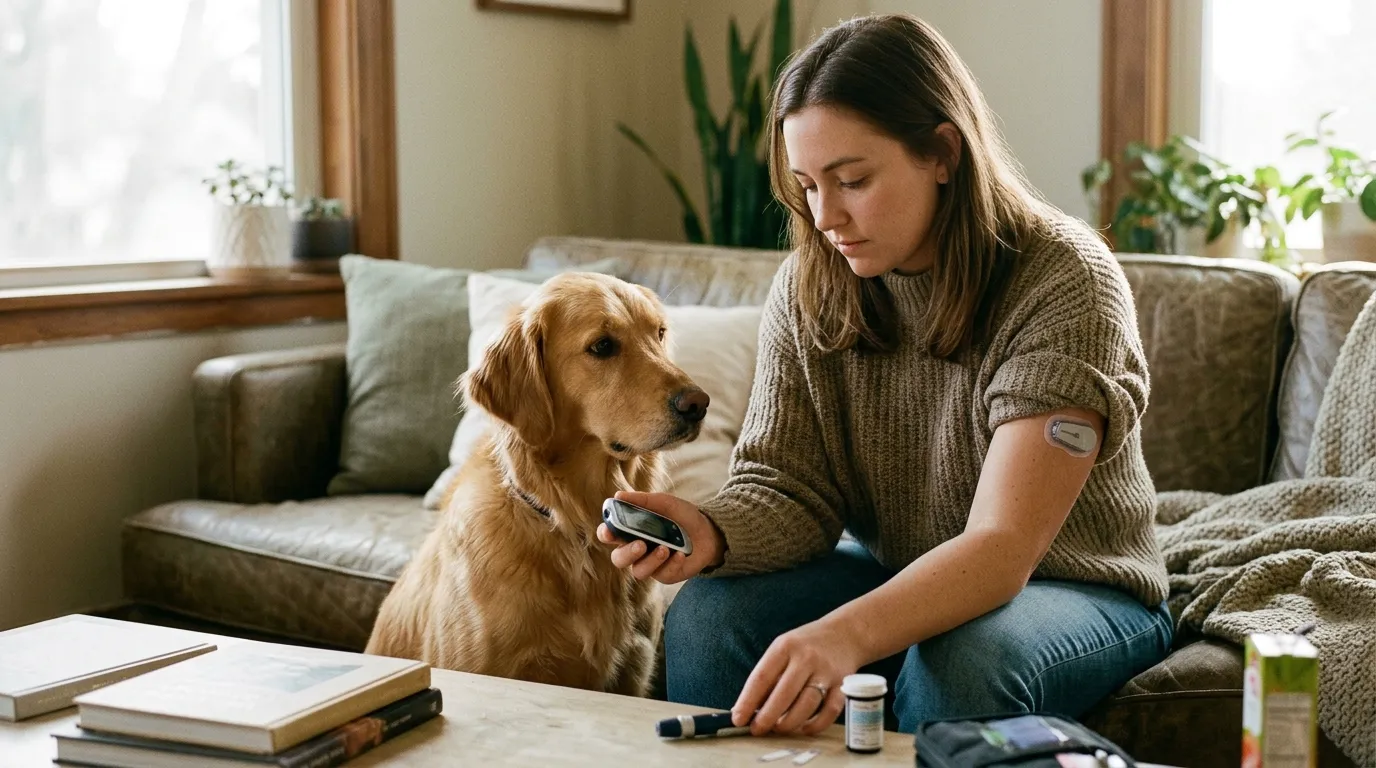
Imagine waking up at 2 a.m. not to an alarm, but to a dog nudging your hand, pressing a paw to your chest, or retrieving your glucose meter from across the room. No device triggered. No app pinged. A nose did. For thousands of people living with Type 1 diabetes, this is not a fantasy — it is Tuesday night.
Diabetic Alert Dogs, commonly known as DADs, are trained scent-detection dogs that monitor their handlers for physiological changes associated with dangerous blood sugar fluctuations. They can detect both hypoglycemia — dangerously low blood glucose — and hyperglycemia — abnormally high glucose — before the person is fully aware something is wrong. In a condition where timing is everything, that early warning can be the difference between a managed episode and a medical emergency.
The Biology Behind Blood Sugar and Scent
To understand how a dog’s nose can function as a blood sugar monitor, it helps to understand what actually happens in the body during a hypoglycemic or hyperglycemic episode. When blood glucose drops below safe levels, the body undergoes a cascade of metabolic changes. Among these changes is the production and release of specific volatile organic compounds — VOCs — through breath, sweat, and skin.
Isoprene is one compound that increases measurably in the breath during hypoglycemia. Other aldehydes and ketone bodies — including acetone, which gives the breath a faintly sweet or fruity odor during diabetic ketoacidosis associated with severe hyperglycemia — also shift in concentration as glucose levels change. These chemical shifts are imperceptible to the human nose. But to a dog with up to 300 million olfactory receptors and a brain wired to analyze scent with extraordinary precision, they are unmistakable signals.
As we explore in our guide on why your dog’s sense of smell is far superior to yours, dogs experience the chemical world at a level of resolution that no human sensory system can match — and it is exactly this capability that makes diabetic alert work biologically plausible and scientifically validated.
What Diabetic Alert Dogs Actually Detect
The specific target scent that DADs are trained to recognize is the VOC profile associated with low blood glucose — most commonly in the breath or sweat of their handler. Training typically involves exposing the dog to sweat or breath samples collected from the handler during a confirmed hypoglycemic episode, then reinforcing the dog for correctly identifying those samples in controlled discrimination exercises.
What makes this detection especially remarkable is the specificity required. A DAD must learn to identify its individual handler’s hypoglycemic scent profile — which may vary somewhat depending on diet, activity level, medications, and other biological variables — and discriminate it reliably from the handler’s normal scent across a full range of environments, distractions, and daily contexts.
Detecting Both Lows and Highs
While hypoglycemia is the more immediately life-threatening condition — a sudden severe low can cause loss of consciousness, seizure, or death — well-trained DADs can also alert to hyperglycemia. Research by Nicola Rooney and colleagues at the University of Bristol confirmed that diabetic alert dogs can accurately detect both hyperglycemia and hypoglycemia in their handlers, broadening the safety net they provide beyond the detection of lows alone.
This dual capability is particularly valuable for people who experience hypoglycemia unawareness — a condition where the normal physiological warning signs of low blood sugar, such as shakiness, sweating, and hunger, are blunted or absent. For these individuals, a DAD may be the only early warning system available in the critical window before a dangerous drop becomes a crisis.
How DADs Are Trained
The training of a Diabetic Alert Dog is a specialized, time-intensive process that combines foundational scent detection work with the behavioral reliability required for a medical service animal operating in everyday life. It draws on the same principles of operant conditioning and odor imprinting that underpin all professional detection dog training — reward-based shaping that reinforces the dog for correctly identifying a target scent and alerting in a trained, consistent way.
Scent Imprinting and Sample Training
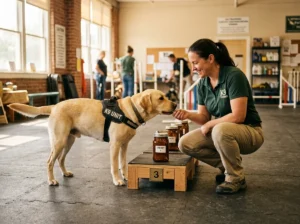
Training begins with scent samples — typically gauze pads, breath samples, or worn clothing collected from the handler during confirmed hypoglycemic episodes, stored in sealed containers and frozen to preserve their chemical profile. The dog is exposed to these samples repeatedly in discrimination exercises, learning to distinguish the target scent from the handler’s normal baseline odors and other distractors.
As the dog becomes proficient at identifying the target scent in controlled conditions, training progressively mirrors real-world situations — working in the home, in public, during sleep, and alongside other people. The dog must learn to alert consistently regardless of context, distraction, or the handler’s activity at the time of detection.
Alert Behaviors — Communicating a Warning
A DAD’s trained alert behavior is its primary communication tool. Common alert behaviors include pawing at the handler, nudging with the nose, performing a specific behavior chain such as retrieving a glucose meter or medical kit, or barking to wake a sleeping handler. Some dogs are also trained to alert a second person — a parent, spouse, or caregiver — if the handler is non-responsive.
The reliability of the alert behavior is as critical as the accuracy of the detection. A dog that detects correctly but alerts inconsistently — or alerts enthusiastically but for the wrong reasons — provides unreliable safety. This is why professional training programs emphasize behavioral precision alongside olfactory training, and why handler education in reinforcing correct alert behavior at home is an essential component of the partnership.
What the Research Shows — Accuracy, Limitations, and Promise
The scientific literature on DAD accuracy presents a nuanced picture — one that validates the fundamental capability of these dogs while also highlighting important variability in real-world performance.
The 2026 Scoping Review — Growing Evidence, Ongoing Questions
A January 2026 scoping review published in Medical Sciences examined the available evidence on Diabetic Alert Dogs as an adjunctive strategy for glycemic monitoring in Type 1 diabetes. The review found that DADs have been increasingly used and that growing interest is backed by a body of research confirming their biological capability — but also that the available evidence remains heterogeneous, with significant variation in study methodology, training standards, and performance measurement making direct comparisons difficult.
This is a familiar challenge in the broader field of medical detection dogs, as we explore in our complete guide to medical detection dogs and disease screening. The science confirms the capability; the challenge lies in standardizing training, certification, and real-world performance evaluation to the level required for widespread clinical integration.
Owner-Independent Testing — A More Rigorous Standard
One of the most important methodological advances in DAD research is the move toward owner-independent performance evaluation. Early studies relied heavily on owner-reported alerts, which are subject to recall bias and expectation effects. More rigorous research, including a study published in Frontiers in Veterinary Science, used objective, owner-independent measures to assess DAD performance — a standard that more accurately reflects what dogs can reliably do in the real world rather than what owners believe they are doing.
These studies confirm that well-trained DADs do alert at significantly higher rates during hypoglycemic events than during normal glucose periods. However, they also document meaningful false-positive rates — alerts during euglycemia — and note that continuous glucose monitoring technology frequently detects hypoglycemia before the dog does when both are available simultaneously. The scientific consensus is not that DADs replace technology, but that they complement it — particularly during sleep, technology failure, or in settings where a device alarm would go unnoticed.
The Hypoglycemia Unawareness Case
For people with hypoglycemia unawareness — estimated to affect up to 25 percent of people with long-standing Type 1 diabetes — the value proposition of a DAD shifts significantly. When the body’s own physiological warning system is compromised, a dog’s nose may provide the only early alert available before blood glucose drops to a level that causes impaired consciousness. In this population, a DAD is not a redundancy. It is a primary safety system.
Who Benefits Most from a Diabetic Alert Dog
DADs are not the right solution for every person with diabetes. They require a significant investment of time, money, and ongoing training effort — and their performance depends heavily on the quality of the initial training program, the individual dog’s aptitude and temperament, and the handler’s commitment to maintaining the alert behavior through consistent reinforcement at home.
Ideal Candidates for a DAD Partnership
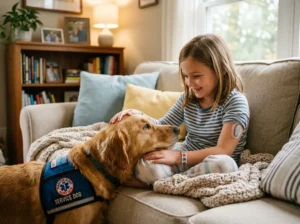
People who are most likely to benefit from a Diabetic Alert Dog include those with frequent or severe hypoglycemic episodes, those with hypoglycemia unawareness, children whose parents or caregivers need an additional nighttime monitoring layer, and individuals who have experienced hypoglycemia-related emergencies and whose quality of life is significantly impacted by fear of future episodes. For these individuals, the psychological benefit of having a trained dog — the reduction in anxiety, the improved sleep quality, the restored sense of security — is often reported as significant as the physical safety benefit.
Choosing a Reputable Training Program
Because DAD training is not yet governed by uniform national certification standards in most countries, the quality of programs varies considerably. Prospective handlers should seek programs that use positive reinforcement-based training methods, provide documentation of training methodology and performance testing, offer ongoing handler education and support, and are willing to provide references from current clients. A dog sourced from a reputable program will have been individually temperament-tested, scent-imprinted on the handler’s specific samples during training, and evaluated for reliable public access behavior before placement.
The American Kennel Club’s guidance on Diabetic Alert Dogs provides a useful overview of what to look for in a trained DAD and what to expect from the partnership — a helpful starting point for anyone considering this option.
A Nose That Never Clocks Out
What makes Diabetic Alert Dogs remarkable is not any single detection event. It is the continuity. A continuous glucose monitor alerts when blood sugar crosses a programmed threshold. A DAD monitors constantly — during sleep, during exercise, during social situations where checking a device would be disruptive or impossible — with no battery requirement and no connectivity gap.
The dog does not interpret data. It follows its nose, applies its training, and communicates what it detects through the alert behavior it has been taught. In doing so, it provides something that no device yet manufactured can fully replicate: a living, attentive, and endlessly motivated safety partner whose sensitivity to the chemical language of the body never turns off.
For a broader understanding of just how many life-saving applications this remarkable biological capability supports, read our article on how scent-detection dogs save lives in the field — and the real people and animals whose lives have been changed by a dog’s extraordinary nose.