
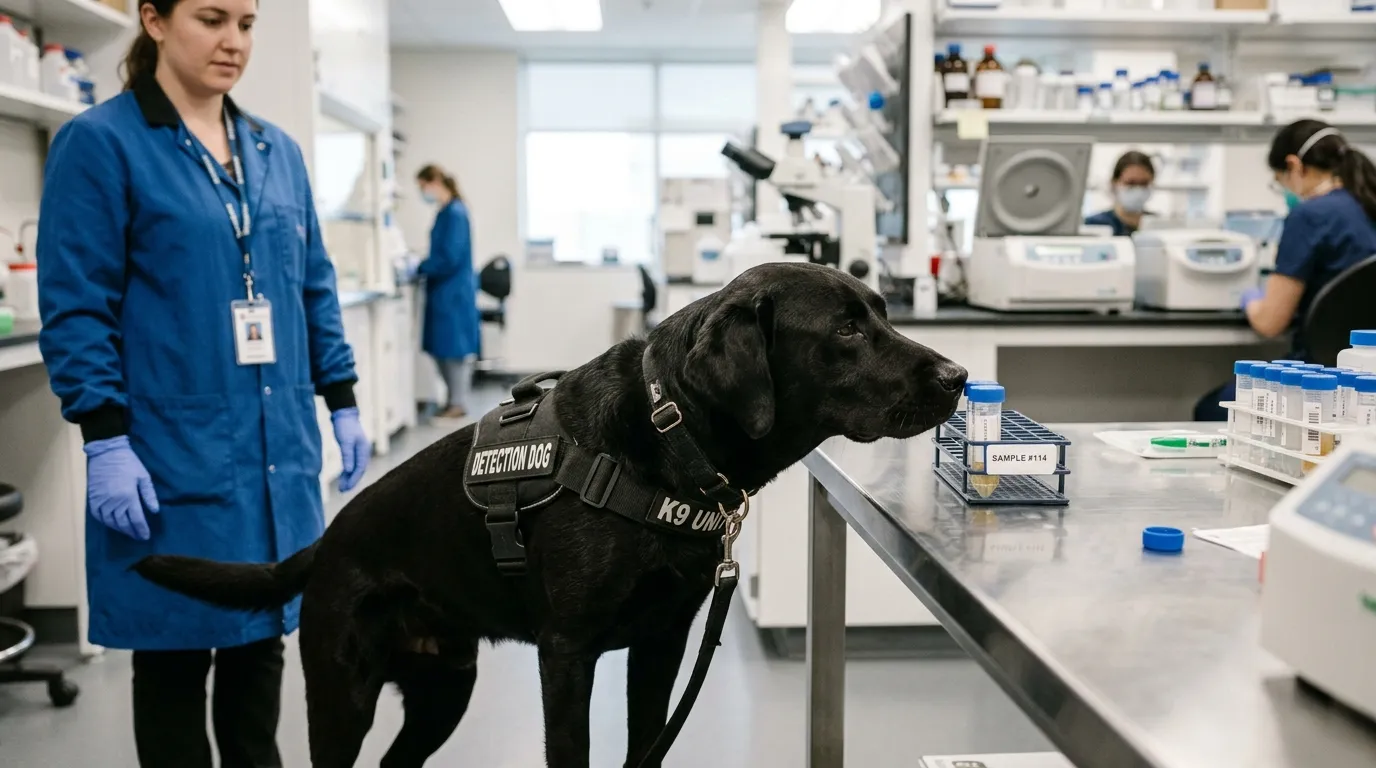
Every year, thousands of dogs are lost to a cancer their owners never saw coming. Hemangiosarcoma — an aggressive malignant cancer of the blood vessel cells — has long been called a silent killer, and for good reason. Most dogs show no symptoms at all until a tumor ruptures, causing sudden internal bleeding and a collapse that often leaves owners and veterinarians with almost no time to act.
But a landmark study published in early 2026 by researchers at the University of Pennsylvania’s School of Veterinary Medicine has offered something rare in the world of canine oncology — genuine hope. Trained bio-detection dogs, using nothing more than their extraordinary sense of smell, were able to identify hemangiosarcoma in blood samples with a 70 percent accuracy rate. It is a finding that could change how this devastating disease is caught, treated, and ultimately survived.
What Is Hemangiosarcoma — and Why Is It So Dangerous?
Hemangiosarcoma is a malignant tumor that originates in the cells lining blood vessels. It can develop almost anywhere in the body, but the most common and dangerous sites are the spleen, heart, and liver. Because blood vessels are found throughout the body, the cancer spreads rapidly once it takes hold.
What makes it especially devastating is its stealth. Unlike many cancers that produce visible symptoms over time, hemangiosarcoma typically develops silently. A dog may appear completely healthy — eating well, playing normally, showing no signs of distress — right up until a splenic tumor ruptures and causes life-threatening internal hemorrhage. By the time a diagnosis is made, the disease has often already spread.
Which Dogs Are Most at Risk?
While hemangiosarcoma can affect any breed, certain dogs face a significantly higher risk. According to the AKC Canine Health Foundation, the disease is responsible for the death of one in five Golden Retrievers in the United States. Portuguese Water Dogs, Boxers, German Shepherds, and Labrador Retrievers are also among the breeds most commonly affected.
Large and giant breed dogs are generally at higher risk, and the disease most commonly strikes dogs in their middle to senior years — typically between the ages of eight and thirteen. Studies suggest that between one-third and one-half of all dogs will develop cancer during their lifetime, making hemangiosarcoma one of the most important health challenges facing dogs today.
The Problem With Current Detection
There is currently no reliable, non-invasive screening tool for hemangiosarcoma. Routine blood work rarely reveals anything unusual until the disease is very advanced. Imaging studies such as ultrasound or CT scans can detect tumors, but they are typically only ordered when a dog is already showing symptoms — which, with hemangiosarcoma, often means the situation is already critical.
This diagnostic gap is precisely what makes the Penn Vet research so significant. If hemangiosarcoma has a detectable scent profile, then early screening becomes possible in a way it never has been before.
The Science Behind Canine Cancer Detection

To understand why dogs might be able to detect cancer by smell, it helps to understand what they are actually detecting. Cancer cells — including those associated with hemangiosarcoma — produce distinctive volatile organic compounds, or VOCs, as byproducts of their abnormal metabolic activity. These compounds circulate in the bloodstream and eventually become present in breath, urine, sweat, and other biological fluids.
Dogs, with their extraordinary olfactory systems, can detect these compounds at concentrations far below what any current analytical instrument can measure. As we explored in our article on how dogs use their sense of smell, a dog’s nose contains up to 300 million olfactory receptors — compared to roughly 5 to 6 million in humans — and the part of the brain dedicated to analyzing scent is proportionally about 40 times larger than our own.
This biological architecture gives dogs the ability to detect scent signatures that are invisible to every other form of detection we currently have. Previous research has demonstrated that dogs can detect human ovarian cancer, pancreatic cancer, lung cancer, and prostate cancer through scent. The Penn Vet study asked whether the same principle could apply to hemangiosarcoma in dogs themselves — and the answer appears to be yes.
How the Penn Vet Study Worked
The study was led by Dr. Cynthia M. Otto, professor of working dog sciences and sports medicine and executive director of the Penn Vet Working Dog Center, and postdoctoral research fellow Clara Wilson. Their team recruited five trained bio-detection dogs — dogs that had already been trained to recognize odors associated with other diseases including chronic wasting disease, post-traumatic stress disorder, human ovarian cancer, and human pancreatic cancer.
The dogs were tested using blood serum samples drawn from three groups: dogs confirmed to have hemangiosarcoma, dogs with other non-cancerous diseases, and healthy dogs. Critically, none of the samples used during testing had been part of the dogs’ initial training — this was a genuine test of their ability to generalize a scent signature they had learned to new, unseen samples.
The Olfactometer — Precision Science Meets Canine Ability
The testing was conducted using olfactometers — highly specialized scent detection devices that ensure rigorous, double-blinded conditions. Each olfactometer contains a small infrared laser beam that registers when a dog’s nose enters the sample port. If the dog stays in that beam long enough, and the sample is the correct one, a tone sounds and the dog receives its reward.
This system eliminates the possibility of handler cuing — a known challenge in canine detection research where subtle, unconscious body language from a handler might influence a dog’s alert behavior. The double-blinded design meant that neither the dogs’ handlers nor the researchers scoring the results knew which samples contained hemangiosarcoma during each trial.
The Results — 70 Percent Accuracy and What It Means
Across all trials, the dogs correctly identified the hemangiosarcoma samples approximately 70 percent of the time. While that number might sound modest in isolation, it falls directly within the range consistently observed in peer-reviewed studies of dogs detecting human cancers — a more established field of research. Detecting cancer by scent is an extraordinarily complex task, and the fact that five dogs with no prior hemangiosarcoma training achieved this level of accuracy on their first exposure to these samples is, as Wilson described it, “very encouraging.”
Equally significant was what the results confirmed at a foundational level: hemangiosarcoma does have a distinct, detectable scent profile. That proof of concept is the critical first step toward developing a practical screening tool.
What This Means for the Future of Canine Cancer Screening
The immediate practical goal of this research is not to place detection dogs in every veterinary clinic. That would be logistically complex and expensive at scale. Instead, researchers hope that understanding the scent profile of hemangiosarcoma will eventually lead to the development of a machine-based electronic nose — a synthetic device that can replicate what the dogs are detecting and translate it into a reliable, affordable diagnostic test.
The Case for Annual Scent Screening
Wilson suggested that a scent-based test could potentially be used as part of an annual wellness screening for at-risk breeds. Rather than replacing imaging or bloodwork, it would function as an early flag — identifying dogs that warrant further investigation before symptoms appear, before a tumor ruptures, and while treatment options are still meaningful.
The implications are significant. If hemangiosarcoma can be identified before a splenic tumor ruptures, a veterinarian could recommend a prophylactic splenectomy — removal of the spleen before catastrophic bleeding occurs — or begin chemotherapy at an earlier stage, when it has a greater chance of extending survival. Currently, the median survival time after diagnosis of splenic hemangiosarcoma with surgery and chemotherapy is only four to six months. Earlier detection could change that prognosis substantially.
Opening Doors for Treatment Research
Earlier detection would also unlock a critical bottleneck in hemangiosarcoma treatment research. Clinical trials for new therapies require enrolling dogs at a known stage of the disease. Because hemangiosarcoma is so rarely caught early, most research has been limited to studying dogs already in advanced stages. A reliable early screening tool would allow researchers to enroll dogs sooner, test more targeted treatments, and gather better data on what works — and when.
This is why Wilson called the study results “an initial kernel of hope.” It is not a finished solution. It is the beginning of a scientific pathway that, followed carefully, could lead to genuinely transformative outcomes for the hundreds of thousands of dogs who develop this disease each year.
What This Means for Dog Owners
For dog owners — particularly those with breeds at elevated risk — this research carries a message worth holding onto. The question is no longer whether hemangiosarcoma has a detectable scent. It does. The question now is how quickly and how reliably that scent can be captured and translated into a clinical tool that reaches everyday veterinary practice.
In the meantime, awareness remains the most powerful tool available. Knowing your dog’s breed risk profile, maintaining regular veterinary wellness checks, and discussing abdominal ultrasound screening with your vet if you have a high-risk dog are all practical steps that can improve the odds of catching something early.
The Broader Picture — Dogs Helping Dogs

There is something quietly remarkable about the fact that dogs — the very animals most affected by hemangiosarcoma — are also the ones leading the way toward a solution. The bio-detection dogs in the Penn Vet study had previously been trained to detect diseases in humans. Now, their abilities are being turned toward saving members of their own species.
It is a reminder of what we explore throughout this site: the canine nose is not just a biological curiosity. It is a precision instrument capable of detecting what no machine currently can, and when applied with rigorous training and scientific care, it becomes something that changes lives. To understand more about how these trained dogs are already saving lives beyond the laboratory, read our piece on how scent-detection dogs save lives in the field.
A Disease That Demands Better Tools — and a Nose That May Provide Them
Hemangiosarcoma has taken too many dogs too soon, too quietly, and with too little warning. For decades, the lack of an early detection tool has meant that most diagnoses arrive in the same devastating way — a healthy dog, a sudden collapse, and a diagnosis that leaves almost no time.
The Penn Vet hemangiosarcoma study does not solve that problem today. But it proves, with scientific rigor, that the problem is solvable. Hemangiosarcoma has a smell. Dogs can find it. And with continued research, investment, and the partnership between canine biology and human ingenuity, a screening tool that brings that ability into the clinic is within reach.
For the dogs waiting on the other side of that research — and for the owners who love them — that is everything.
Want to learn more about the science behind what makes dogs such extraordinary disease detectors? Explore our in-depth guide on medical detection dogs and disease screening to see the full scope of what trained canines can do.