
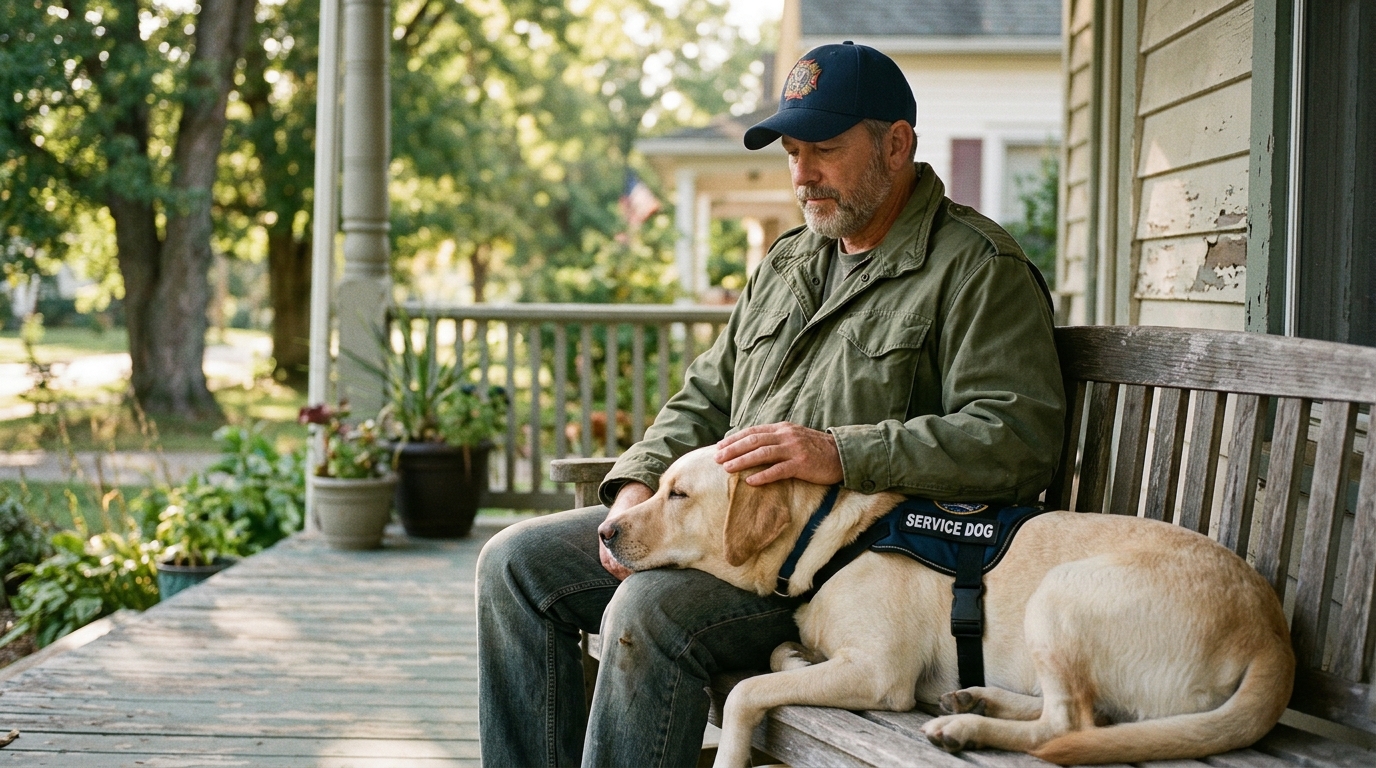
A flashback does not announce itself. One moment a person is present — in a grocery store, at a family dinner, asleep in their own bed — and the next they are somewhere else entirely, pulled back into a trauma their nervous system has never fully processed. For the millions of people living with post-traumatic stress disorder, this is not a metaphor. It is the lived reality of a condition that hijacks the mind and body without warning and without permission.
Now, a landmark scientific study has raised a possibility that could change how PTSD episodes are managed — not through medication, not through wearable technology, but through a dog’s nose. Research published in 2024 out of Dalhousie University in Canada has demonstrated for the first time that trained scent-detection dogs can identify volatile organic compounds in the breath of people experiencing PTSD-related distress — potentially alerting their handlers to an oncoming episode before the person is consciously aware it is beginning.
It is among the most significant findings in the growing field of psychiatric scent detection, and it has profound implications for how we think about service dogs, mental health support, and the extraordinary biological capabilities of the canine nose.
Understanding PTSD — The Scale of the Problem
Post-traumatic stress disorder is one of the most prevalent and debilitating mental health conditions in the world. It develops in some people following exposure to a traumatic event — combat, sexual assault, natural disaster, serious accident, or other life-threatening experiences — and is characterized by intrusive memories, hyperarousal, emotional numbing, and persistent avoidance of anything associated with the trauma.
According to the National Institute of Mental Health, PTSD affects people of all ages, backgrounds, and genders. Veterans, first responders, survivors of violence, and refugees are among the populations with the highest prevalence rates. A 2024 umbrella review estimated overall PTSD prevalence at approximately 24 percent across exposed populations — a figure that underscores the enormous scale of unmet need for effective, accessible support tools.
Existing treatments — including cognitive processing therapy, prolonged exposure therapy, and pharmacological approaches — are effective for many people but not all. Treatment access remains uneven, stigma reduces help-seeking, and the unpredictable nature of PTSD episodes — particularly intrusive symptoms like flashbacks and hyperarousal — continues to impose severe limitations on the daily lives of those affected.
The Biology of PTSD and Scent
To understand how a dog could detect a PTSD episode through smell, it is important to understand what is happening in the body during a trauma response. PTSD is characterized at the neurological level by chronic overactivity of the amygdala — the brain region responsible for processing fear and threat — and dysregulation of the stress response system. When a person with PTSD is exposed to a trauma cue, the amygdala activates the body’s fight-or-flight cascade before the conscious mind has fully registered the trigger.
This cascade produces measurable physiological changes: elevated cortisol and adrenaline, increased heart rate, changes in skin conductance, and — critically — shifts in the profile of volatile organic compounds released through breath, sweat, and skin. These VOC changes are the chemical fingerprint of the stress response, and they occur at the molecular level before the person may be fully aware of their own distress.
As we examine in our article on dogs detecting human stress and how it affects their mood, dogs are already known to detect stress-related chemical changes in humans — a capability rooted in the same extraordinary olfactory biology that makes them effective in every other domain of scent detection. The question the Dalhousie researchers asked was whether that general stress detection could be refined to specifically identify the scent profile of PTSD-related distress.

The Dalhousie Study — What the Research Found
The proof-of-concept study, published in Frontiers in Allergy and led by Laura Kiiroja and colleagues at Dalhousie University’s Canine Olfaction Lab and Mood, Anxiety, and Addictions Comorbidity Lab, was the first to investigate whether dogs could detect the specific VOC signature associated with PTSD symptom onset rather than general stress.
Study Design — Rigorous and Carefully Controlled
The researchers recruited 26 human participants — 54 percent of whom met the diagnostic criteria for PTSD — and collected breath samples during two states: a calm baseline condition and a stressed state induced by personalized trauma cue exposure. Participants wore facemasks while being reminded of their traumatic experiences, and the breath samples collected during these sessions were preserved for use in dog detection trials.
Two scent-detection dogs — Ivy and Callie — were selected from an initial pool of 25 pet dogs based on their aptitude and motivation for scent work. They were trained using a two-alternative forced choice discrimination task, learning to distinguish between the calm baseline sample and the trauma-exposed stressed sample from the same individual. A second detection task then tested whether the dogs could generalize the target odor — identifying trauma-related stress scent across different individuals and across different stressful events experienced by the same person.
The Results — 90 Percent Discrimination Accuracy
The findings were striking. Across all sample sets in the discrimination experiment, the dogs performed at approximately 90 percent accuracy — correctly distinguishing the trauma-exposed breath samples from the calm baseline samples at a rate far exceeding chance. In the more challenging generalization detection task, they achieved 74 and 81 percent accuracy respectively — still well above chance and consistent with accuracy rates reported in other areas of medical scent detection research.
Further analysis suggested that the dogs may have been detecting distinct endocrine stress markers — the chemical byproducts of hormonal stress activity — rather than general arousal signals. One dog’s performance correlated with the trauma cue exposure rating provided by human donors, suggesting a dose-response relationship between the intensity of the stress response and the detectability of its scent signature.
Why This Is a Breakthrough
The significance of this study lies not just in the accuracy figures but in what they demonstrate at a conceptual level. Prior to this research, PTSD service dogs were trained to respond to visible behavioral cues of distress — fidgeting, fist-clenching, changes in posture or breathing that signal an oncoming episode. This approach depends on the dog observing a behavioral change that is already underway — by which point the person may already be partially into an episode.
If dogs can detect the chemical precursors of a PTSD episode through breath — changes that occur at the level of the stress hormone cascade, before behavioral symptoms are visible — they could potentially interrupt the episode at an earlier biological stage. That earlier intervention window could make a meaningful difference to both the severity of the episode and the person’s ability to deploy coping strategies before they are overwhelmed.
How PTSD Service Dogs Currently Work — and How This Changes Things
PTSD service dogs are already one of the most valued and widely discussed complementary interventions for trauma survivors. According to the VA National Center for PTSD, growing evidence links service dog use with clinically significant long-term decreases in PTSD symptomatology, with the strongest effects for intrusion and hyperarousal symptoms — precisely the symptoms most associated with flashbacks and panic episodes.
Veterans, first responders, and civilian trauma survivors who use PTSD service dogs consistently report improvements in quality of life, social functioning, and the ability to engage in daily activities that PTSD had previously made difficult or impossible. Among the tasks most appreciated by handlers, alerting to and interrupting episodes of distress ranks in the top three — making the reliability and timeliness of that alert behavior critically important.
From Behavioral Cues to Chemical Cues
The current training paradigm — teaching dogs to respond to visible behavioral signs of distress — is effective but limited by the visibility requirement. Some people with PTSD internalize their distress with little outward behavioral change until an episode is well advanced. Others experience rapid-onset intrusive symptoms with very little warning behavioral window for a dog to detect and respond to.
Scent-based alerting would bypass the behavioral observation requirement entirely. A dog trained to the breath VOC profile of its handler’s PTSD stress response could theoretically detect an oncoming episode while the handler still appears calm — providing an alert that allows the person to exit a triggering environment, use a grounding technique, contact a support person, or take medication before the episode reaches its peak.
Sleep and Nighttime Application
One of the most debilitating aspects of PTSD for many sufferers is nighttime — nightmares, hyperarousal during sleep, and the exhaustion that comes from disrupted rest. A dog trained to detect the scent of PTSD-related distress could potentially alert to a building trauma response during sleep, allowing early intervention before a nightmare reaches full intensity. This nighttime application — analogous to the role diabetic alert dogs play in detecting overnight hypoglycemia — could represent one of the most practically valuable aspects of scent-based PTSD alerting.
This parallels the broader pattern in medical scent detection we explore throughout our article on medical detection dogs and disease screening — where the timing of detection is often as critical as the accuracy of the detection itself.
What This Means for Veterans and PTSD Sufferers
For veterans and civilians living with PTSD, the implications of this research are both practical and deeply personal. The Dalhousie study is a proof-of-concept — it demonstrates the biological feasibility of scent-based PTSD detection and establishes the foundational evidence needed to pursue larger, more targeted research. It does not yet represent a clinical protocol ready for immediate deployment.
What Comes Next — The Research Pathway
The next steps identified by the researchers include expanding the sample size, refining training protocols to focus specifically on individual handler scent profiles, and conducting field trials with service dog teams in real-world PTSD management contexts. As with all medical detection dog research, the path from proof-of-concept to validated clinical application requires rigorous replication, standardization of training methodology, and performance evaluation under real-world conditions.
But the direction of travel is clear. The question is no longer whether PTSD has a detectable scent. It does — and trained dogs can find it. The question now is how precisely, how reliably, and how quickly that capability can be developed into a training protocol that meaningfully improves outcomes for the people who need it most.
The Broader Message — The Nose Knows Mental Health Too
For a long time, the conversation about detection dogs and human health focused on physical conditions — cancer, diabetes, infections, seizures. The Dalhousie study signals that the frontier of medical scent detection is expanding into mental health — a domain where the need for better tools is enormous and where the limitations of existing interventions leave many people without adequate support.
A dog that can smell a flashback coming is not science fiction. It is emerging science — rigorously designed, carefully documented, and pointing toward a future in which the bond between humans and dogs extends into some of the most invisible and underserved dimensions of human suffering.
To understand the full scope of what trained scent-detection dogs are capable of across health, safety, and human wellbeing, read our in-depth feature on how scent-detection dogs save lives in the field — and the remarkable animals behind each of those stories.
A Nose Before the Storm
PTSD takes so much from the people it affects — sleep, safety, spontaneity, and the ability to be fully present in their own lives. Any tool that gives those things back — even partially, even incrementally — matters. A dog that can detect the chemical warning signs of a trauma response before it peaks is not just a companion. It is a first responder operating at the molecular level, working from a sense so precise it can read the invisible chemistry of a nervous system under siege.
The science is still early. But the nose has already answered the most important question. It knows. And now, so do we.