
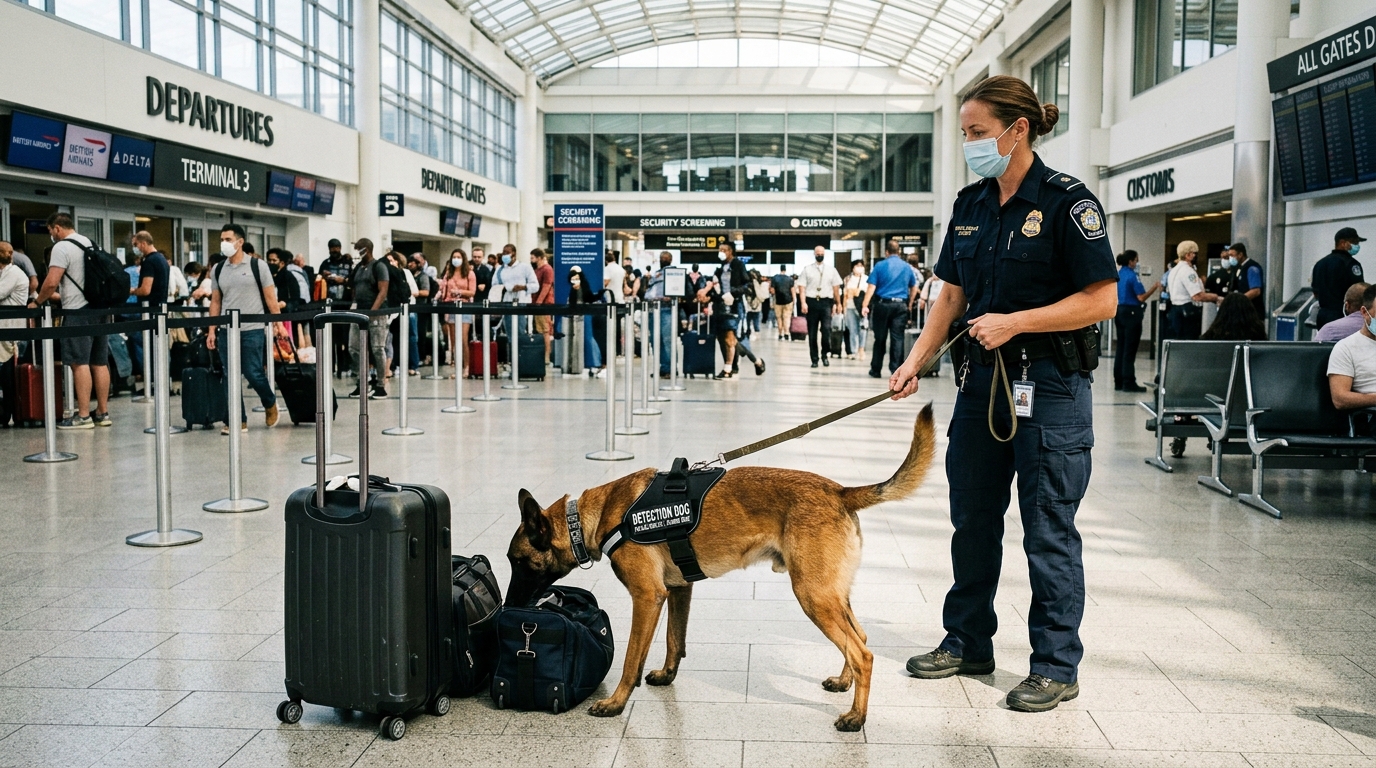
In the early months of 2020, as the world scrambled to develop tests, build hospital capacity, and understand a virus that was spreading faster than any diagnostic tool could track it, a small group of researchers quietly proposed an alternative. What if dogs could screen for COVID-19? What if the same biological capability that finds explosives in airports and cancer in blood samples could be turned toward a pandemic pathogen — faster, cheaper, and more scalable than any machine?
Within months, studies from Finland, Germany, Colombia, France, Lebanon, the United Arab Emirates, and Rwanda were all reporting the same thing: trained detection dogs could identify COVID-19 positive individuals with extraordinary accuracy — in some studies matching or exceeding the performance of PCR testing, at a fraction of the cost, and at a speed that no laboratory process can approach.
The pandemic did not create this capability. It revealed it — at scale, under pressure, and in the most consequential public health emergency in a generation. What we learned has permanently changed what the world knows about dogs as infectious disease detectors, and what it should expect from them in future outbreaks.
How Dogs Were Deployed During COVID-19
Detection dog COVID-19 programs launched with remarkable speed across multiple countries. In Finland, trained dogs were deployed at Helsinki Airport as early as September 2020, screening arriving passengers using sweat samples collected via skin pads. In Germany, researchers at the University of Veterinary Medicine Hannover trained eight dogs in just one week to detect SARS-CoV-2 in inactivated saliva samples, achieving an average detection rate of 94 percent in a randomized, double-blind study. In Lebanon, the UAE, and several other countries, dogs were stationed at airports and border crossings, providing a rapid first-pass screening layer that complemented PCR and antigen testing.
Speed and Scale — What Made Dogs Different
The operational advantages of detection dogs over laboratory testing became immediately apparent. A trained dog can screen an individual in seconds — compared to hours for PCR testing and the turnaround time required for antigen processing at scale. In practice, dog detection teams were able to screen hundreds of people per hour in high-throughput environments like airports and metro systems, providing a real-time screening capacity that no testing infrastructure could match in the early stages of the pandemic.
In Medellin, Colombia, a real-world effectiveness study published in PLOS ONE deployed three trained detection dogs in the city’s metro system without prior public announcement, screening 550 volunteers who also agreed to PCR testing. The dogs achieved a negative predictive value of 99 percent — meaning that when a dog did not alert, the person was almost certainly not infected. In a mass screening context, this ability to reliably clear large numbers of people quickly is precisely the bottleneck that pandemic response needs to break.
Asymptomatic Detection — A Critical Advantage
One of the most significant findings across multiple COVID-19 detection dog studies was the dogs’ ability to identify asymptomatic infections — individuals who were carrying the virus and were capable of transmitting it, but who showed no symptoms and would not have sought testing on their own. A 2024 study published in the Journal of the American Veterinary Medical Association found that dogs trained to detect COVID-19 in live individuals achieved 94 to 96 percent positive and negative agreement with PCR testing — and that their performance held across both symptomatic and asymptomatic subjects.
This is a capability that transforms the value proposition of dog-based screening. Rapid antigen tests are less sensitive in asymptomatic individuals. PCR testing requires laboratory infrastructure and time. Dogs, detecting the volatile organic compound signature of the virus rather than responding to visible symptoms, do not distinguish between symptomatic and asymptomatic infections — they detect the chemistry of the disease regardless of how it presents in the host.
The Science — What Dogs Were Actually Detecting

To understand why dogs can detect COVID-19, it helps to understand what they are detecting at the molecular level. SARS-CoV-2 infection triggers a cascade of metabolic changes in the host — alterations in cellular processes, immune activation, and the production of viral proteins and metabolites that enter the bloodstream and are eventually released through breath, sweat, and skin as volatile organic compounds.
These VOCs constitute a chemical fingerprint of active infection — distinct from the person’s healthy baseline scent and, critically, distinct from other respiratory infections. Dogs trained on COVID-19 positive samples learned to identify this specific VOC profile and discriminate it from negative samples, from samples from people with other illnesses, and from the wide range of competing scents present in real-world screening environments.
Cross-Variant Detection
One of the more remarkable findings from COVID-19 detection dog research was the apparent ability of trained dogs to detect infections across different SARS-CoV-2 variants. A study from Rwanda, published in Frontiers in Medicine, compared dog detection performance during the Delta wave and the Omicron wave. While sensitivity decreased during Omicron — consistent with the substantial mutations that characterized that variant — specificity remained high across both, and the dogs continued to identify true positives at rates that maintained their utility as a screening tool.
This cross-variant detection capability reflects a fundamental property of canine olfactory detection: dogs are likely detecting a broad VOC signature associated with the infection process rather than a single compound specific to one variant. As the virus mutates and the specific VOC profile shifts, the breadth of the dog’s trained scent recognition — built across many positive samples — may provide a degree of resilience that single-compound electronic sensors struggle to match.
Long COVID — A New Detection Frontier
The application of detection dogs to COVID-19 did not end with the acute infection phase. Researchers at the University of Veterinary Medicine Hannover investigated whether dogs trained to detect acute COVID-19 could also identify Long COVID — the persistent post-infection condition affecting millions of people worldwide. Their pilot study found that dogs achieved a mean sensitivity of 94.4 percent and specificity of 96.1 percent for Long COVID samples, suggesting that the post-infection physiological state produces its own distinct VOC profile that trained dogs can identify. This is an area of rapidly developing research with significant implications for Long COVID diagnosis — a condition that currently lacks reliable biomarkers and is frequently missed or misdiagnosed.
Cost, Accessibility, and Global Health Equity
Beyond accuracy, the COVID-19 detection dog studies revealed a compelling case for dog-based screening on economic and accessibility grounds. The Rwanda study, which screened 5,253 participants using sweat samples, calculated a marginal cost of approximately $2.67 per sample using trained detection dogs — compared to significantly higher costs for antigen rapid diagnostic tests, particularly in low- and middle-income countries where laboratory infrastructure is limited.
The Equity Argument for Bio-Detection Dogs
This cost differential has real global health significance. During COVID-19, testing capacity was one of the most significant barriers to effective outbreak response in low-income countries. Laboratory infrastructure took months to scale. PCR testing costs were prohibitive at population scale without international support. Rapid antigen tests, while cheaper, had lower sensitivity — particularly in asymptomatic populations.
Trained detection dogs require an upfront investment in training but can then operate at very low marginal cost per screening, require no laboratory consumables, and can be deployed in any environment accessible to a dog and handler — including rural areas, border crossings, community health posts, and informal settlements where laboratory testing is simply not available. For pandemic preparedness planning, this positions bio-detection dogs as a genuinely viable tool for low-resource settings that existing diagnostic technologies consistently underserve.
Training Speed — A Critical Pandemic Asset
Another operationally significant finding from the COVID-19 detection dog experience was the speed with which dogs could be trained. The Hannover team trained eight dogs to detect SARS-CoV-2 in just one week. Other programs reported training timelines of eight to ten weeks from initial imprinting to deployment-ready standard. This speed — combined with the dogs’ ability to begin screening immediately upon deployment — represents a response capability that no laboratory diagnostic scale-up can match in the early days of a novel outbreak.
In the critical first weeks of a new pandemic, when no specific diagnostic test exists and the pathogen’s VOC profile has not yet been fully characterized, dogs trained on biological samples from confirmed cases could potentially begin population screening before any laboratory test is available. This early detection window — compressing the time between outbreak emergence and effective screening deployment — could meaningfully alter the trajectory of a future pandemic.
As we explore in our article on medical detection dogs and disease screening, this capacity to be trained rapidly on novel target scents is one of the most distinctive advantages of biological detection over technology-based alternatives. A dog does not need to know the molecular structure of a pathogen to detect it — it needs only a training sample and the reward-based conditioning that turns its extraordinary nose toward a new target.
What COVID-19 Taught Us About Bio-Detection Dogs
The COVID-19 pandemic produced more peer-reviewed research on detection dog infectious disease screening in three years than the preceding three decades combined. The weight of that evidence has shifted the scientific and public health conversation in ways that will outlast the pandemic itself.
From Curiosity to Credibility
Before 2020, the idea of deploying detection dogs for infectious disease screening at airports and mass gathering events was largely theoretical — discussed in academic papers but rarely implemented at scale. COVID-19 forced that implementation, generating real-world performance data across diverse populations, environments, and variants that no controlled study could have produced. The result is a body of evidence that positions bio-detection dogs not as a curiosity or a complement of last resort, but as a legitimate, deployable public health tool with demonstrated performance, cost advantages, and operational characteristics that no alternative currently replicates.
The Road to Standardization
What remains to be built is the infrastructure of standardization — consistent training protocols, certification standards, quality assurance frameworks, and regulatory pathways that would allow bio-detection dog programs to be deployed as credentialed public health interventions rather than ad hoc emergency measures. The COVID-19 experience made the case for that infrastructure. The next pandemic will require it to already be in place.
This is the lesson the pandemic leaves for canine bio-detection: the capability is not in question. The preparedness is. To understand the full range of what trained detection dogs are currently contributing to human health and safety — from cancer detection to conservation — read our in-depth feature on how scent-detection dogs save lives in the field.
The Dog at the Frontier of Pandemic Preparedness
SARS-CoV-2 will not be the last novel pathogen to threaten global health. The conditions that produced it — habitat encroachment, wildlife trade, dense urban populations, and rapid international travel — remain in place and are intensifying. The next outbreak will arrive without warning, without an existing diagnostic test, and with the same desperate need for rapid, scalable, cost-effective screening that defined the first months of COVID-19.
Detection dogs will be ready. They were ready in 2020. They will be ready again — trained in weeks, deployed immediately, screening hundreds of people per hour at the cost of a few dollars per sample, detecting the chemical signature of infection before laboratory science has caught up with it. The pandemic revealed a capability that has always been there, in every dog’s nose, waiting for the world to take it seriously.
Now the world knows. The question is whether it will be prepared to use it. To explore how the training behind this capability works — from initial scent imprinting to real-world deployment — read our comprehensive guide on how detection dogs are trained.