
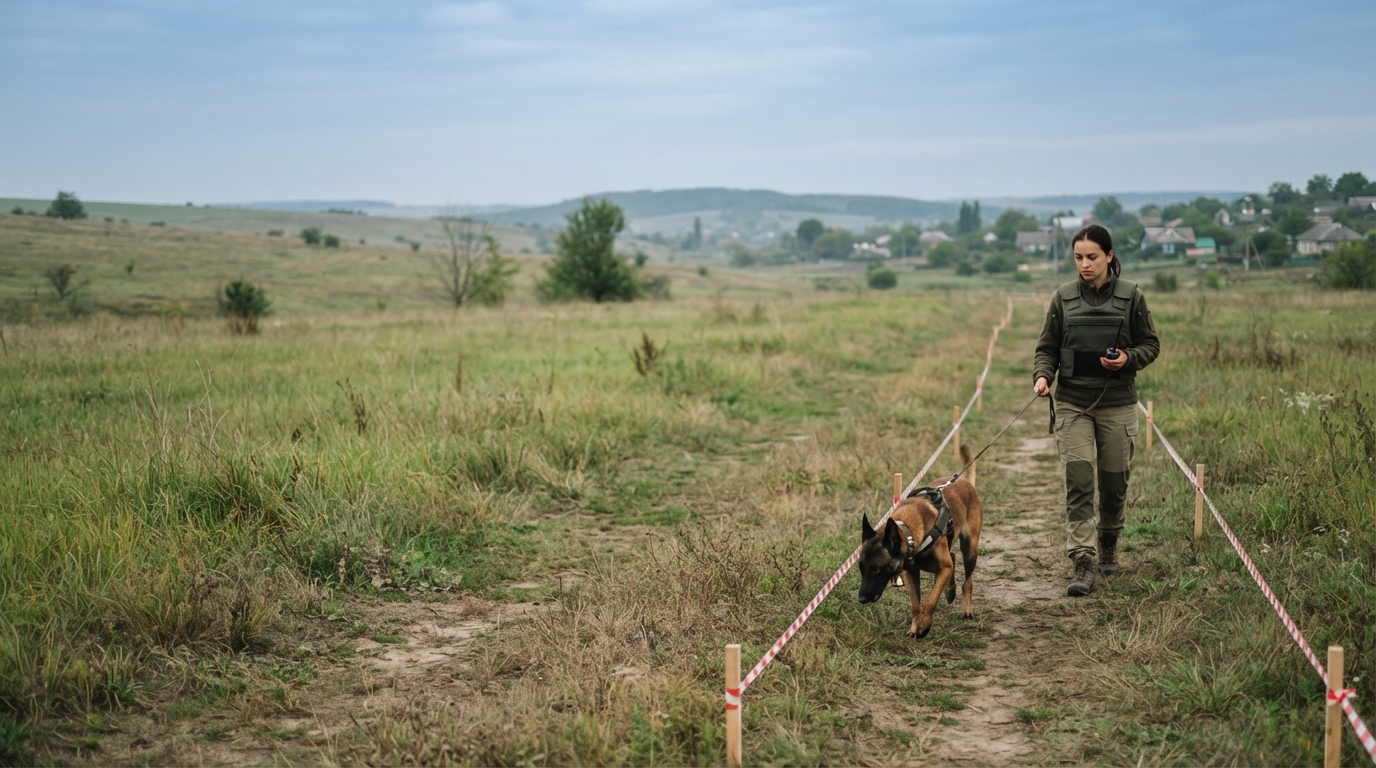
Technical Survey Dogs in Ukraine support a carefully managed humanitarian mine-action effort. They do not make a field safe by themselves. They help trained teams gather evidence about possible explosive hazards so specialists can decide what further action is needed.
This distinction matters. In areas affected by landmines and explosive ordnance, one reliable indication can help focus professional resources. A non-indication does not create a public guarantee that land is safe. The work depends on trained dog-handler teams, approved procedures, manual verification, quality management and decisions made by accredited mine-action authorities.
This is different from ordinary search and rescue. A search-and-rescue dog is trained to locate people or human scent. A Technical Survey Dog, often called a TSD, indicates scent associated with explosive hazards in a defined mine-action setting. Both are skilled working dogs, but they answer different questions within different safety systems.
What a Technical Survey Dog does
A Technical Survey Dog helps a mine-action team investigate land that may contain explosive ordnance. The dog and handler search according to an approved plan, and the handler observes the dog’s behavior for a trained indication. That information can support technical survey, which is the evidence-led process used to clarify the extent and nature of a suspected hazardous area.
Finding odor, not confirming an item
The dog detects an odor associated with the target, not a visible mine or a legal conclusion about the land. A formal indication tells the team that the location needs further professional attention. Explosive ordnance specialists and manual deminers investigate findings under the procedures that govern the operation. This is why it is inaccurate to say that a dog “clears mines” or independently confirms the presence of an explosive item.
In humanitarian mine action, the dog is one part of an Animal Detection System. The International Mine Action Standards describe this as more than an animal and a handler. It includes supervisors, equipment, facilities, policies and procedures that work together to detect vapour from explosive ordnance. The standards recognize dogs as Mine Detection Dogs, Technical Survey Dogs or both, depending on their trained role.
Land release needs evidence
Land release is an evidence-led decision about whether an area needs further action or can be released through approved procedures. A TSD can support that process in areas with low or scattered contamination, but its work must be interpreted with other information. The International Mine Action Standards for animal detection systems address accreditation, testing, planning, environmental conditions, rest and target indications.
Why Ukraine is using Technical Survey Dogs
Ukraine’s mine-action challenge calls for complementary tools. Manual deminers, mechanical assets, survey specialists and other technologies each have a role. TSD teams add a mobile scent-detection capability where contamination, vegetation or metal debris makes survey work difficult. Their contribution is most valuable within an accountable system, not as a stand-alone solution.
In April 2025, Mines Advisory Group reported that four dog-handler teams had deployed in Mykolaiv Oblast to help detect landmines and explosive ordnance in areas heavily shelled in 2022. The organization stated that explosive-ordnance experts would investigate potential dog finds and ensure any confirmed items were safely disposed of. The deployment was presented as a way to demonstrate the Technical Survey Dog method while Ukraine evaluated possible integration into its national mine-action approach. Read MAG’s April 2025 deployment update.
That partnership continued to develop. In September 2025, UNDP, MAG and APOPO demonstrated TSD work with manual demining teams for Ukraine’s State Emergency Service. UNDP described the method as combining canine detection with manual verification and as complementing the manual and mechanical approaches already used by the service. The visits to regional centres were also intended to assess conditions for gradual adoption into Ukraine’s national mine-action framework. Read UNDP’s Technical Survey Dog field-visit report.
Dogs, people and machines work together
TSDs are part of a team, not a substitute for people or equipment. Dogs can help locate odor signatures in vegetation or complex ground conditions. Manual deminers investigate potential finds. Mechanical methods can prepare suitable areas. Survey specialists, supervisors and authorities use combined evidence to manage risk and make land-release decisions.
This division of work also protects the dog and handler. The operation plans search patterns, safe deployment lanes, communication, environmental conditions and safety distances. The public should never replicate this activity, approach a suspected item or enter a marked hazardous area. Move away without touching a possible explosive hazard and notify competent local authorities or emergency services.
Training, accreditation and welfare matter
A working detection dog is developed through a long relationship with its handler. The foundations include target-odor training, a clear alert behavior, distraction proofing and repeated practice in conditions that resemble the operational setting. Our guide explains these principles and how detection dogs are trained through scent imprinting. In mine action, that training must be followed by testing and accreditation specific to the task and national system.
Accreditation is not paperwork alone. It is a way to confirm that an organization and each deployed team meet the performance and quality requirements for live operations. International standards require Animal Detection System organizations to obtain organizational accreditation before starting operations, and deployed units must pass operational accreditation testing. The standards also address animal health, work records, rest and rotation. These safeguards recognize that a reliable team depends on welfare, fitness and consistent performance.
In October 2025, MAG reported that Ukraine’s project had established a training base, an operational base in Mykolaiv, an approved standard operating procedure titled “Use of Technical Survey Dogs,” and national accreditation. The update also said that European Union funding had been agreed to continue the initiative through 2027. Read MAG’s 2025 progress report on Technical Survey Dogs.
How TSDs differ from search and rescue
Both TSDs and search-and-rescue dogs depend on canine scent ability, handler partnership and disciplined training. The difference lies in the target, the operational objective and the safeguards around the search. Search-and-rescue teams look for people, human scent or human remains in environments such as wilderness, disaster sites and water. Technical Survey Dogs support regulated investigation of explosive-hazard contamination.
This difference is more than terminology. Search-and-rescue work aims to locate a person or evidence of a person. Technical survey work helps specialists decide where controlled mine-action resources should be directed. For a broader introduction to people-searching work, read the role of a dog’s nose in search and rescue operations.
A careful role in Ukraine’s recovery
Technical Survey Dogs offer a promising, carefully bounded addition to Ukraine’s mine-action capacity. Their contribution is not a shortcut around verification or safety procedures. It is a way to add canine scent detection to an evidence-based process that already depends on skilled people, standards and accountable decisions.
As Ukraine builds its national capacity, the meaningful measure of success is not a dramatic dog alert. It is whether teams can apply trained detection, manual verification, accreditation and quality management together to help communities make safer decisions about land. In that disciplined role, Technical Survey Dogs can help survey difficult areas while supporting the longer work of recovery.