
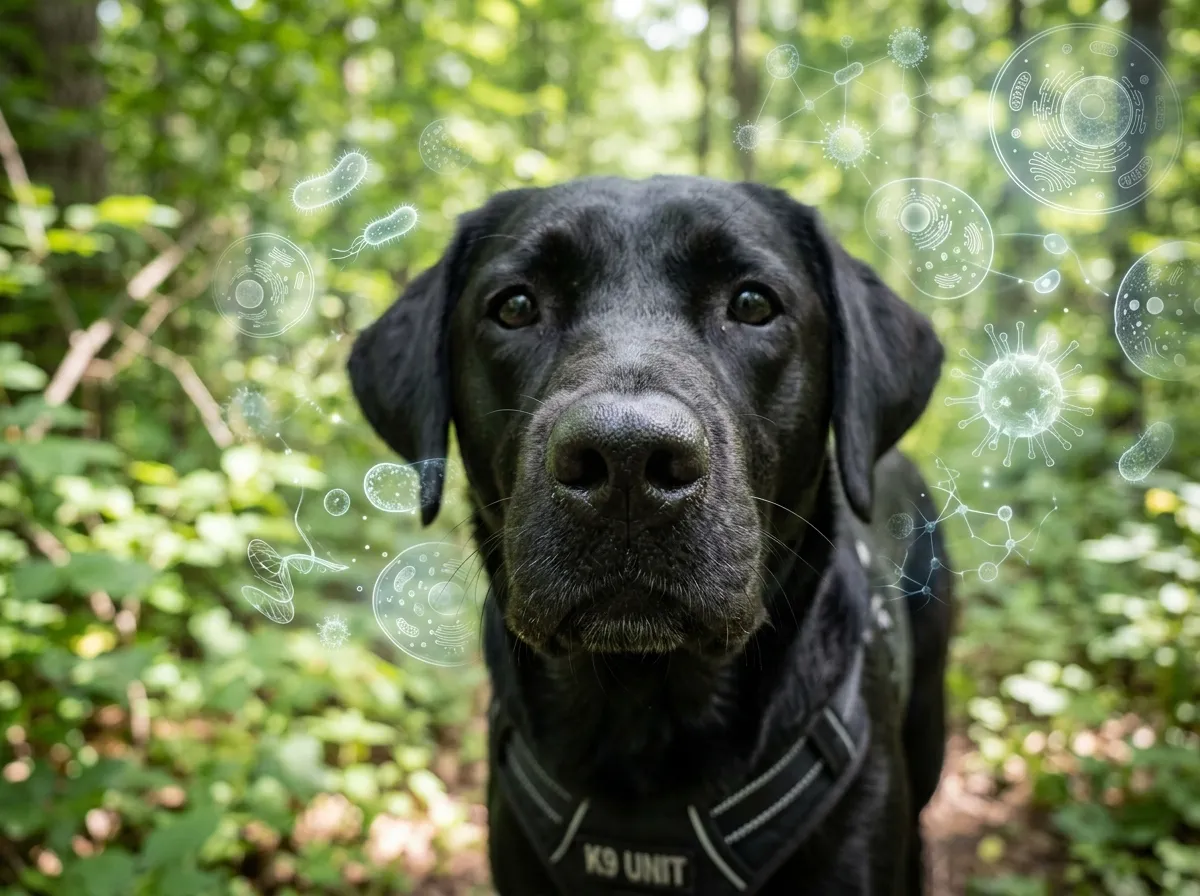
When we think about what makes a detection dog exceptional, we tend to focus on the obvious — the nose itself, the number of olfactory receptors, the size of the brain’s scent-processing center, the hours of training invested with a skilled handler. But emerging research is pointing to a factor that almost no one in the detection community was considering a decade ago: what is happening in the dog’s gut.
The canine microbiome — the vast and complex community of bacteria, fungi, and other microorganisms living throughout a dog’s body, particularly in the gastrointestinal tract — is increasingly understood to have wide-ranging effects on health, behavior, cognition, and now, potentially, olfactory performance. For working dogs whose entire value rests on the precision of their nose, this is a frontier that the science community is only beginning to map.
What Is the Canine Microbiome?
The microbiome is the collective term for the trillions of microorganisms that live within and on a dog’s body. The gastrointestinal microbiome — the largest and most studied component — comprises hundreds of bacterial species that colonize the digestive tract from birth onward, shaped by genetics, diet, environment, stress, medication history, and the microbiomes of the animals and humans a dog lives alongside.
Far from being passive passengers, these microorganisms play active roles in digestion, immune regulation, vitamin synthesis, inflammatory response, and the production of neurotransmitters and other chemical signals that influence brain function and behavior. The gut microbiome communicates with the central nervous system through what is known as the gut-brain axis — a bidirectional signaling network that connects the gastrointestinal tract and the brain via neural, hormonal, and immune pathways.
Why the Microbiome Matters Beyond Digestion
For most of its research history, the canine microbiome was studied primarily in the context of gastrointestinal health — managing diarrhea, inflammatory bowel disease, and digestive disorders. But as understanding of the gut-brain axis has deepened, researchers have begun asking a broader question: if the gut microbiome influences cognition, mood, and behavior in other mammals, could it also influence the olfactory capabilities of dogs?
A landmark review published in Frontiers in Veterinary Science raised exactly this question, proposing that gastrointestinal microbiota likely impacts olfaction via bidirectional communication between the GI tract and brain — and that the microbiome is itself impacted by exercise, diet, and stress. The same variables that shape a detection dog’s physical and psychological readiness, in other words, are also shaping its microbial ecosystem. And that ecosystem may be shaping the nose.
The Gut-Brain-Nose Connection

Understanding how gut microbiota could influence olfactory function requires understanding the gut-brain axis in more detail. The enteric nervous system — sometimes called the “second brain” — is a network of over 500 million neurons lining the gastrointestinal tract. It communicates continuously with the central nervous system, primarily through the vagus nerve, as well as through the release of signaling molecules, hormones, and immune mediators that enter the bloodstream and affect brain function.
The microbiome influences this system at multiple points. Gut bacteria produce short-chain fatty acids, neurotransmitter precursors including serotonin and dopamine, and inflammatory signals that can modulate neural activity throughout the body — including in the olfactory bulb and cortical regions responsible for scent processing and discrimination. A disrupted microbiome — caused by antibiotic use, poor diet, chronic stress, or sudden environmental change — can alter this signaling network in ways that affect cognitive performance, stress reactivity, and potentially the precision of olfactory function.
The Nasal and Oral Microbiome
The connection between microbiome and olfaction is not limited to the gut. Research published in PLOS ONE characterized the nasal and oral microbiota of 81 detection dogs across multiple locations and job categories — including explosive detection dogs, patrol and narcotics dogs, and vapor wake detection dogs. The study found that the nasal microbiome of detection dogs showed measurable differences between job categories and demonstrated temporal variation over time — meaning that the microbial community living in the very tissue through which scent molecules must pass is not static. It changes with conditions, and those changes may influence how olfactory receptor neurons function and respond.
This is a relatively new and still developing area of research, but the implication is significant: the microbiome does not just live alongside the dog’s olfactory system. It may be an active participant in it.
What the Research Tells Us About Working Dogs Specifically
A 2022 study published in npj Biofilms and Microbiomes — one of the most comprehensive investigations of the working dog microbiome to date — analyzed the gut microbiota of 134 working canines using shotgun metagenomic sequencing, then cross-referenced findings against behavioral and performance outcomes. The study found intriguing associations between microbiome composition and working dog behavior, and concluded that further research into the relationship between microbiome, health, and job performance is strongly warranted.
What makes this study particularly relevant for the scent detection community is its scale and methodology. Prior research in this area had been limited by small sample sizes and less precise sequencing techniques. By using shotgun metagenomic sequencing across a large cohort of real working dogs, the researchers were able to characterize the microbiome at a level of resolution that earlier studies could not achieve — and the associations they found open the door to targeted intervention research.
Stress, Travel, and Microbiome Disruption
Two pilot studies investigating search and rescue dogs from the United States Federal Emergency Management Agency found measurable differences in the dogs’ microbiomes following air travel — with plane travel producing a detectable shift in microbiome composition that helicopter travel did not. This finding is more than a curiosity. Detection dogs deployed to disaster sites, international operations, or remote locations frequently travel by air. If that travel disrupts their gut microbiome in ways that affect cognitive or olfactory readiness, it represents a practical operational consideration that no current deployment protocol accounts for.
Stress more broadly — whether from travel, environmental change, handler separation, or inadequate rest — is one of the most established drivers of microbiome disruption. Chronic stress alters gut microbial composition, reduces diversity, and increases intestinal permeability in ways that produce systemic inflammatory signals affecting brain function. For a dog whose job requires sustained, precise olfactory discrimination, the downstream effects of chronic microbiome disruption are not trivial. This connects directly to the broader point we explore in our article on how dogs use their sense of smell — that the nose does not function in isolation from the rest of the animal.
Diet, Gut Diversity, and Detection Readiness
Current studies revealed that the physical condition and olfactory performance of working canines are closely related to the symbiotic microbiome, including the nasal, oral, and gut microbiota — and that alterations of the gut microbiota induced by dietary structure, drug administration, and living environments can all influence the health conditions and olfactory capabilities of detection canines. This finding, published in research from the Shanghai Veterinary Research Institute and Chinese Academy of Agricultural Sciences, frames diet not just as a matter of energy and nutrition but as a direct lever on olfactory readiness.
Diets high in fermentable fiber support the production of short-chain fatty acids by gut bacteria — compounds with well-established anti-inflammatory and neuroprotective effects. High-quality protein sources support the synthesis of neurotransmitter precursors. Omega-3 fatty acids reduce systemic inflammation and support neural membrane integrity. Each of these dietary factors shapes the microbial environment in which a detection dog’s olfactory system operates — and potentially the precision with which that system performs.
What This Means for Detection Dog Programs
The implications of this emerging research extend across every aspect of how working detection dog programs are designed and managed — from the way dogs are fed, to how travel and deployment stress is managed, to how recovery periods between operational assignments are structured.
Rethinking Nutrition as a Performance Variable
Most working dog programs pay close attention to caloric intake, body condition scoring, and physical fitness. Fewer treat nutrition as a variable that directly affects olfactory performance at the neurological level. If the microbiome research continues to develop in the direction current evidence suggests, that will need to change.
The practical question is not just whether a dog is well-fed, but whether its diet supports a diverse, stable gut microbial community that in turn supports optimal neurological function. Fermentable fibers, high-quality animal proteins, and the controlled use of probiotics and prebiotics are all areas where targeted nutritional strategy could, in principle, support the microbiome conditions associated with peak detection performance. A 2025 review published in PMC on dietary modulation of the gut microbiota in dogs confirmed that macronutrient balance, food format, and functional ingredients can meaningfully regulate microbial diversity and host physiology in ways relevant to performance and health.
Managing Stress as Microbiome Management
If stress disrupts the microbiome, and microbiome disruption affects olfactory performance, then stress management in working dog programs is not just a welfare concern — it is an operational one. Dogs that are chronically stressed, under-stimulated, socially isolated, or deployed without adequate recovery time between assignments may be operating with compromised gut microbial ecosystems that limit the precision of the very ability they are being asked to use.
This means that the quality of the handler relationship, the consistency of routine, the availability of appropriate rest and enrichment, and the management of environmental stressors are all factors that connect — through the gut-brain axis — to detection performance. As we examine in our article on the role of a dog’s nose in search and rescue operations, the conditions under which a dog works profoundly shape how effectively it can perform — and microbiome science is now suggesting that those conditions reach deeper into biology than previously understood.
Antibiotic Use and Microbiome Recovery
Antibiotic treatment — frequently necessary in working dogs that sustain injuries or infections in the field — is one of the most significant disruptors of gut microbial diversity. Broad-spectrum antibiotics can substantially alter microbiome composition, reduce beneficial bacterial populations, and create conditions that take weeks or months to normalize. For programs that return dogs to scent work shortly after antibiotic treatment, understanding and supporting microbiome recovery may be as important as monitoring physical recovery.
What Dog Owners and Handlers Can Do Today
The science of the canine microbiome and olfactory performance is still emerging. Causal links between specific microbial profiles and measurable detection accuracy have not yet been established in controlled trials. What the research does clearly support is the broader principle: a dog’s gut health is not separate from its cognitive and sensory performance. They are connected systems, and managing one thoughtfully is managing the other.
Practical Steps Grounded in Current Evidence
For handlers and owners of detection or nose work dogs, the following principles are consistent with current microbiome science and veterinary nutritional guidance. Feed a high-quality, nutrient-dense diet with a stable protein source and adequate fermentable fiber to support microbial diversity. Avoid unnecessary antibiotic use where clinically appropriate, and support microbiome recovery with probiotic and prebiotic supplementation following any antibiotic course, under veterinary guidance. Minimize chronic stress through consistent routines, positive handler relationships, and adequate rest and enrichment between working periods. And when air travel or significant environmental change is unavoidable, be aware that microbiome disruption is a real physiological event — and that performance expectations in the immediate aftermath should account for it.
The Bigger Picture
The canine nose has always been understood as a product of anatomy and training. What the microbiome research is beginning to reveal is that it is also a product of biology in the fullest sense — shaped by what a dog eats, how it lives, how much stress it carries, and the invisible ecosystem of microorganisms that mediates between its gut, its brain, and the world it is trained to detect.
That is not a reason for alarm. It is a reason for a more complete, more holistic understanding of what it means to maintain a working dog at the peak of its extraordinary abilities. To explore how this science connects to the broader picture of canine olfactory capability, read our in-depth article on why your dog’s sense of smell is far superior to yours — and what that means for the work these animals do every day.