
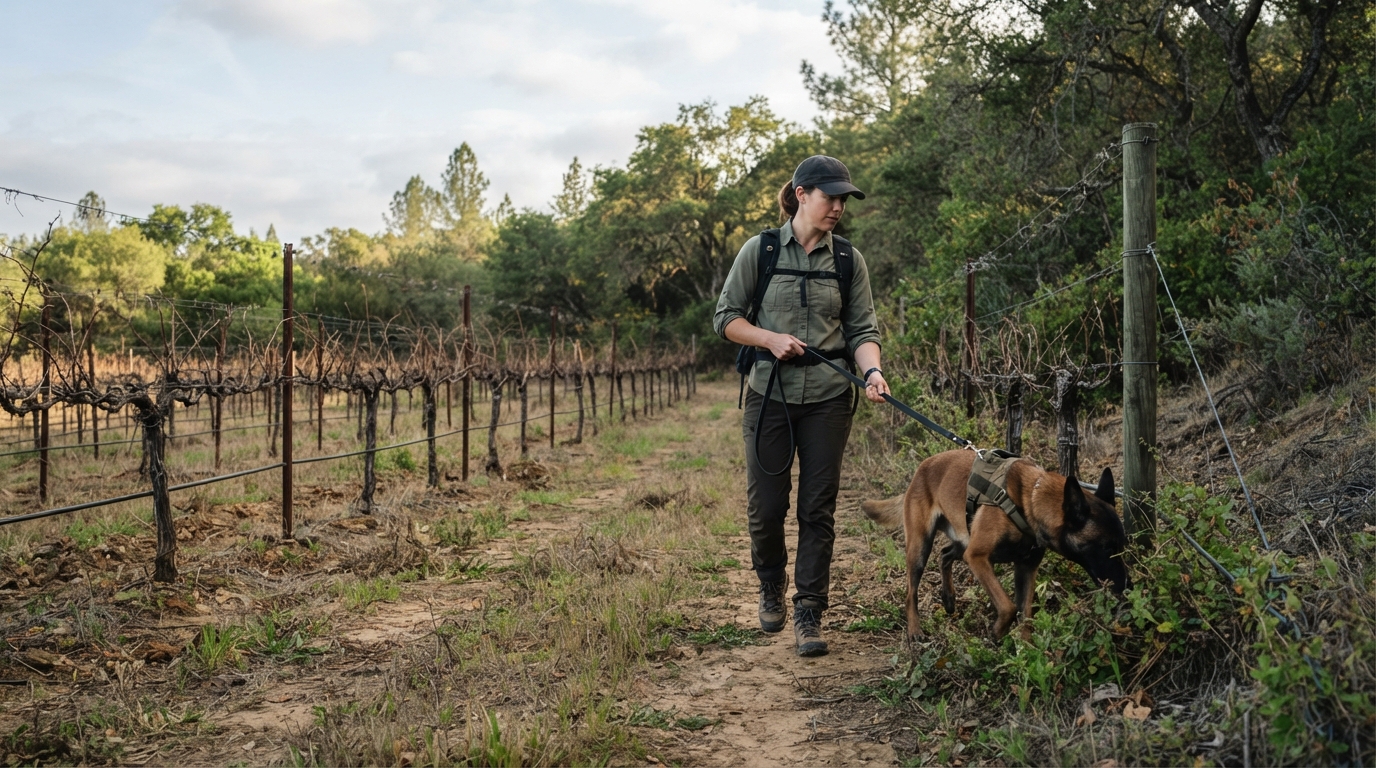
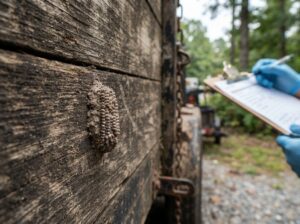
Spotted lanternfly detector dogs show how a trained nose can support a critical plant-health job: finding an invasive pest before it spreads. The spotted lanternfly is an invasive planthopper that can affect grapevines, hops, stone fruit trees and hardwoods. It also travels easily because it lays egg masses on hard surfaces such as vehicles, equipment and firewood.
An egg mass may blend into bark, a trailer or a nursery shipment. A trained dog can search for its target odor in a complex environment and help inspectors focus visual checks and follow-up work. This is a specialized biosecurity role, not a task for an untrained pet or a replacement for official inspection.
For readers who know how conservation detection dogs help researchers and wildlife managers, spotted lanternfly work is a practical extension. Here, the dog helps protect plant industries and forests by finding a small, cryptic threat early.
Why early lanternfly detection matters
The U.S. Department of Agriculture describes the spotted lanternfly as a hitchhiking pest. It lays eggs on smooth outdoor surfaces, then moves with people and commerce into new areas. The insect feeds on many plants and produces honeydew, which can promote sooty mold growth. In August 2025, USDA APHIS reported infestations in 19 states and the District of Columbia.
For a nursery, vineyard, orchard or landscape business, this creates a real inspection challenge. Staff must look beyond obvious host plants and consider the items that move between properties. Egg masses can appear in fall, winter and spring, when an infestation may be easier to interrupt but the target can still be hard to spot. The USDA APHIS spotted lanternfly guidance explains what to look for and directs the public to state-specific reporting contacts.
A detection dog does not identify a pest by itself. Its alert tells an inspector where to examine, document and follow the proper process. Reliable biosecurity depends on trained teams, verification and clear reporting, not on a single alert.
What detector dogs add to inspections
Dogs are useful when visual searching is slow, targets are sparse or the search area is cluttered. A dog and handler can survey a location methodically, then direct attention to places that deserve closer visual inspection.
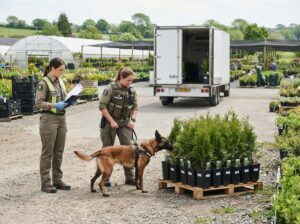
Tennessee offers a recent example. In August 2025, the Tennessee Department of Agriculture announced that USDA-trained dogs Winnie and Marcel had joined plant inspectors. The teams worked in areas with reports that had not been visually confirmed, contributing to a detection in Sumner County. The department also described retail plant-dealer inspections and potential support for nursery shipments near a confirmed finding. Read the Tennessee Department of Agriculture announcement.
This is not a story about dogs working alone. The useful unit is the dog-handler-inspector team. The handler reads the dog’s search behavior, the inspector examines the area, and the responsible agency determines the next step. That model creates a practical bridge between canine scent work and regulated plant-health decisions.
What the 2025 research shows
Controlled testing is promising
A 2025 study in PeerJ examined whether community science dog-handler teams could learn to detect devitalized spotted lanternfly egg masses. After three to six months of independent training, the teams achieved 82 percent sensitivity in a controlled odor-recognition test and 58 percent sensitivity in field conditions. The study is encouraging because it shows that dogs with prior scent-work experience can learn a new, agriculturally relevant target odor. It is also a reminder that performance in a controlled setup and performance outdoors are not the same thing. Read the PeerJ study.
Search conditions change the result
Field setting matters. Cornell researchers compared trained dogs and people searching for egg masses in vineyards and nearby forests. People found more egg masses in vineyards, where vines and support poles allowed a systematic visual search. Dogs made more detections in adjacent forests, where the terrain was more complex and the target was harder to see. That is the useful lesson for any inspection program: choose the tool that fits the environment rather than assuming one method wins everywhere. See Cornell’s report on the vineyard and forest study.
How training supports reliable alerts
Professional detector dogs learn through reward-based scent work. Teams must also work around distractors, blank search areas and changes in weather, surface and odor concentration. A dog that succeeds only in a familiar training room is not ready for a nursery, forest or retail setting.
That progression is why quality control matters. Training aids must be handled carefully to reduce contamination. Searches need planned blank areas so a dog does not learn that every search contains a target. Handlers need to understand changes in behavior that may signal odor interest before the final alert. For a closer look at the foundations, see our guide to how detection dogs are trained through scent imprinting.
For spotted lanternfly work, teams also need an operating framework. The dog should not be asked to confirm a species, authorize movement of plants or replace visual inspection. The alert begins an evidence-gathering process. Inspectors can check the location, collect any required documentation and report through the correct authority. This approach protects both the value of the dog’s work and the integrity of a biosecurity program.
What growers and residents can do
Most people do not need a detector dog to help limit the spread of spotted lanternfly. They do need to be alert when moving outdoor items, vehicles, boats, firewood or equipment. Check surfaces before traveling from an area with known lanternfly activity, and learn the appearance of egg masses, nymphs and adults from official guidance. If you find a suspected lanternfly or egg mass, follow your state’s reporting instructions rather than relying on a social media identification.
Growers and nursery operators can treat detector dogs as one possible layer in a broader prevention plan. Strong plans also include staff training, routine visual inspections, record keeping, compliance with local quarantine requirements and rapid contact with plant-health officials when there is a concern. A canine team may increase the chance of finding a difficult target, but it works best when the surrounding program is organized and responsive.
A practical future for canine biosecurity
Spotted lanternfly detector dogs show why canine scent work matters beyond police, medical and search-and-rescue settings. They can help professionals locate targets that are easy to miss, especially in complex environments where early action has the greatest value. The strongest version of this work is not a dramatic claim that a dog can solve an invasive-species problem alone. It is a disciplined partnership among trained dogs, capable handlers, inspectors, researchers and public reporting systems.
As more agencies test and deploy these teams, the most useful question is not whether dogs are better than people in every situation. It is where a trained nose adds the most value, how alerts are verified, and how the information helps people act sooner. In that role, spotted lanternfly detector dogs can become an important part of protecting nurseries, vineyards and forests from a pest that is built to travel.